
What is overstimulation in motherhood?
Overstimulation in motherhood is what happens when your nervous system takes in more sensory input than it can process and tips into overwhelm. It is the noise, the touching, the constant needing, and the never-ending demands all landing at once, until your body feels like it wants to crawl out of its own skin.
It is a signal that your system has been asked to absorb too much, for too long, with too little quiet.

What it looks like
You might be struggling with overstimulation if…
It is the everyday sign that the input has outrun what your nervous system can hold. Any of these can be part of it.

Common questions

Why am I so overstimulated as a mom?
Because motherhood asks your nervous system to absorb more sensory input than it can process, all day, with almost no quiet.
- The sensory input never stopsMotherhood floods the senses all day, the noise, the touching, the constant needing, with almost no pause to recover, so the load keeps building with no break.
- You are running every tab at onceYou are tracking, planning, and remembering a dozen things in your head while you also process everything happening around you, and holding both at once is more than any nervous system can filter for long.
- It accumulates with nowhere to goMost of us were never taught how to reset our nervous system, so the charge from the day builds and builds without a release, until it finally spills over.



Is being this overstimulated just part of being a mom?
Some sensory overwhelm comes with the territory, but feeling constantly on edge and like you want to crawl out of your skin is not a price you simply have to pay. Being told it is keeps too many moms suffering quietly.
Key terms
The language of overstimulation
Naming what is happening takes some of its power away. These are the terms that make sensory overwhelm easier to see and to talk about.
- What is overstimulation?
- Overstimulation is when your nervous system takes in more sensory input, noise, touch, and constant needing, than it can process, and tips into overwhelm. It is a signal your system needs a break it is not getting.
- What does touched out mean?
- Touched out is sensory overload from constant physical contact, the point where one more hand or body against yours feels unbearable, even from the people you love. It is your body asking for room to reset, not a sign you are unaffectionate.
- What is sensory overload?
- Sensory overload is when sights, sounds, and touch pile up faster than your brain can filter them, and the input starts to feel painful or panicky. Sound is often the fastest trigger for a mom running near her limit.
- What is nervous system dysregulation?
- Nervous system dysregulation is when your body gets stuck in a high-alert state and struggles to settle back down between demands. Regulation is the skill of bringing yourself back to baseline instead of staying revved past your limit.


Why do I feel so touched out?
Being touched out is sensory overload from contact. After a day of being climbed on, leaned against, and tugged at, one more touch can feel like too much.
- Contact stacks like any other inputA whole day of being held onto, climbed on, and tugged at with no physical space adds up the same way noise does, until by evening even loving touch can feel like too much.
- It does not measure your loveFeeling touched out is your body asking for room, not a sign you are cold or that you love your people any less.
- Small breaks rebuild your toleranceYou do not need hours alone, since even short pockets of uninterrupted, untouched time bring your tolerance back enough that the next ask of contact lands more gently.
How therapy helps
How therapy helps with overstimulation
Overstimulation rarely eases by simply trying to tolerate more. It eases when you can catch the overload earlier, regulate your nervous system, and build real recovery time back into your days. A maternal mental health therapist can help you get there.

Learn your early overload signals
We help you recognize the signs in your own body that you are reaching your limit, so you can act before the overwhelm spills over.
Build nervous-system regulation skills
With the right tools, you can learn to bring your body back down when the input peaks, and respond instead of snapping.
Reduce stress and overwhelm
We’ll guide you in creating a plan to manage the mental load of motherhood and access the support you need to feel more grounded.
Protect recovery and quiet time
Together we look at where real rest and sensory breaks can fit into your life, and how to ask for the support that makes them possible.

How do I stop overstimulation from turning into yelling?
You catch it earlier. Overstimulation builds quietly until it spills over, so the work happens before that point, not in the blowup.
- Learn your early signalsThe clenched jaw, the rising heat, and the urge to flee the room show up before the snap does, and treating those as a cue to act is what keeps the overload from reaching your kids.
- Lower the input where you canOnce you notice the signs, the move is to cut the load, not white-knuckle it: step out for a minute, mute the noise, hand off contact, or say out loud that you are at capacity.
- Give the overwhelm somewhere to goThis is not about being a perfectly calm mom, it is about building a release valve so the overstimulation has an outlet that is not your children.
Free tool
~5 minFreeThe Mom Rage Map
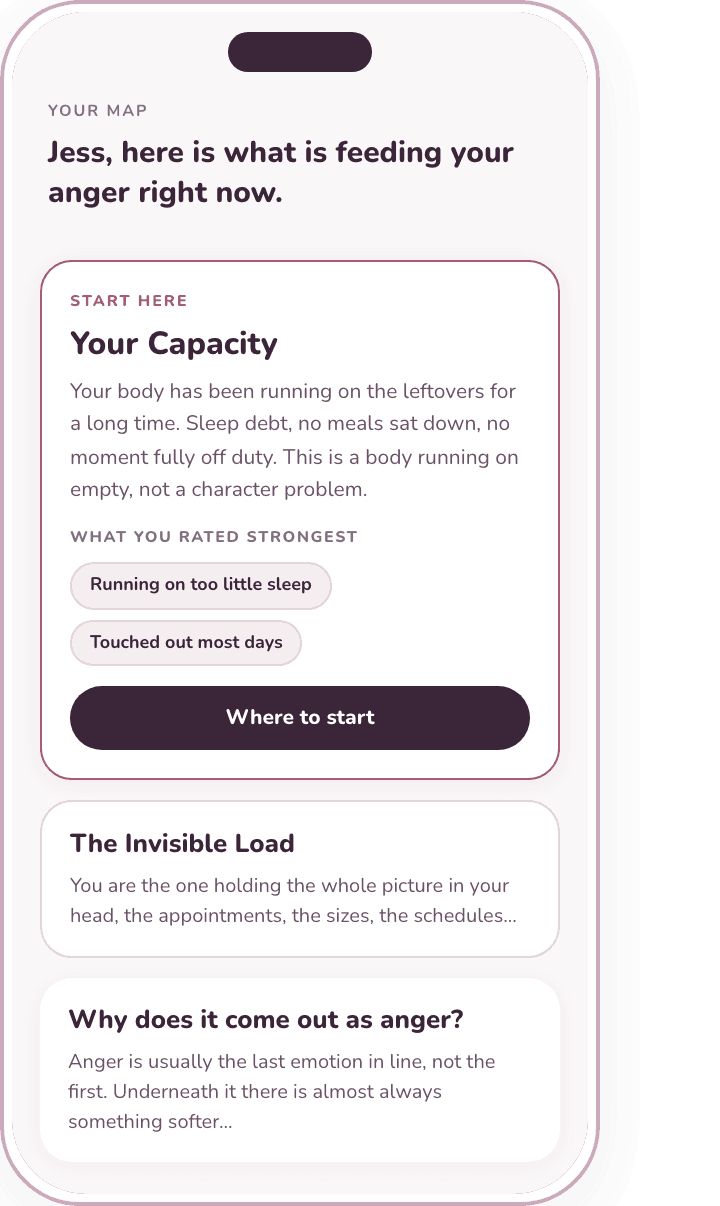
You love your kids, and you still find yourself snapping over the small stuff, then sitting in the guilt afterward. The Mom Rage Map shows you what is actually fueling that anger across nine areas of your life, not just how to hold it in.
It starts with what your nervous system has left to absorb the noise, the touch, and the constant being-needed, so the overstimulation that tips you into anger shows up plainly, with one place to start.
Free tools and resources
Start with what your system needs, free and at your own pace.



What clients say
Mom-centered, judgment-free care on your terms.
“I was struggling so much and feeling extremely overwhelmed as a new mother when I discovered Momwell. I thought I was the only one struggling and that there was something wrong with me for not being able to handle it all. After listening to the podcast, I’m feeling so much more like myself again! Motherhood is still hard, but I feel like I can finally breathe and enjoy it. Thank you, Erica!”
“I’d just gotten done crying after yelling at my children for the 100th time that day, feeling like I was a terrible mother, when I found the Mom Rage course. It was so comforting to hear people talking about exactly what I was going through–with NO judgment. I left with the tools I needed to recognize when I’m getting overwhelmed and bring myself back down. Our lives have gotten so much easier–I’m so grateful to Momwell!”