
When ADHD hides behind the mental load
Is it ADHD, or is it motherhood? It can be both, and the only way to know is to look closely. In moms, ADHD often hides behind the mental load: the tasks you start but cannot finish, the time that slips away, and reactions that land harder than the moment called for.
Momwell gives you three ways to understand what is going on and get real support: a free screener to explore the patterns, a formal assessment when you want a diagnosis, and therapy built for how your brain actually works.

Three ways in
Start wherever you are
Free tool
ADHD Screener for Moms
Mom brain, burnout, or something more? A clinically informed screen for how ADHD shows up in motherhood. It explores the patterns; it is not a diagnosis.
Psychological assessment
ADHD Assessment
A comprehensive evaluation including a clinical interview, an assessment battery, and validated rating scales, conducted by a doctoral-level psychologist. A private pay service; check your eligibility when you book.
Therapy
ADHD-informed therapy
Motherhood raises the executive function demand in ways that can push an unrecognized brain past what it can absorb. That is a neurological reality, and it deserves real support.
What it looks like
You might recognize yourself in more of this than you expected
If more than one of these feels true, it is worth paying attention to.

Common questions

Can therapy help with ADHD and motherhood before a diagnosis?
Support does not wait on a label. If what you are noticing is wearing on your daily life, that is reason enough to start.
- You can build the tools without a diagnosisA diagnosis can help, but you do not need one to start. Therapy teaches the skills for attention, time, and emotion either way, so the work can begin now.
- Your therapist helps you weigh a diagnosisTogether you can figure out whether pursuing a formal diagnosis would actually be useful for you, what it would change, and where to go for one.
- A diagnosis is not the finish lineEven with one, there are still skills to learn. A diagnosis names what is going on; therapy is where you learn to work with it day to day.



Is it really harder to mother with ADHD?
For some moms there is something underneath the invisible load that makes the demand land differently, and naming it is not weakness, it is the start of getting the right kind of support.

Isn’t this just mom brain that everyone feels?
Mom brain is the forgetfulness that comes from exhaustion and carrying too much, and it tends to lift as sleep and the load ease. ADHD is different: it is in how the brain manages attention, time, and emotion, and it was there long before motherhood.
- Mom brain comes and goesThe fog of early motherhood is real and usually tied to sleep loss, hormones, and a plate that is too full. It tends to ease as those do.
- ADHD is in how the brain worksADHD shapes executive function, the planning, starting, remembering, and switching a day demands, along with how strongly time and emotion register. It is a neurological difference, not a season.
- It was there before the babyADHD predates motherhood, even when no one named it. Motherhood just raises the demand until the old workarounds stop holding, which is why it can feel like it appeared out of nowhere.
Key terms
The language of ADHD in motherhood
Having words for what motherhood feels like with an ADHD brain takes some of the self-blame out of it. These are the terms that make the experience easier to see and to talk about.
- What does ADHD look like in moms?
- In moms it often looks less like restlessness and more like a mind that will not slow down while the laundry, the appointments, and the half-read texts keep stacking up. It can mean bursts of focus and creativity alongside the tasks, the time, and the conversations that slip away no matter how hard you try.
- What is executive function?
- Executive function is the set of mental skills that plan, sequence, start, and switch between everything a day asks of you. Motherhood leans on it constantly, so when those skills work differently, the ordinary logistics of family life can take far more effort than anyone sees.
- What is rejection sensitive dysphoria?
- Rejection sensitive dysphoria is the heightened sensitivity to criticism, or even the fear of it, that many people with ADHD carry after years of being corrected for how their brain works. A small comment, or the sense that you have let someone down, can land hard enough to feel like too much. For many moms it is the ache underneath the guilt after a difficult moment.
- Why is motherhood harder with ADHD?
- Motherhood multiplies the planning, remembering, and emotional steadiness it asks for, all at once and without a pause. For a brain that was already compensating quietly, that rising demand is often the point where the old strategies stop keeping up. That is a real reason for support.

I’ve always managed, so it probably isn’t ADHD, right?
Managing is not the same as the absence of ADHD. It often means you built quiet systems that hid how hard you were working.
- Managing can be its own kind of effortMany women with ADHD have spent years building compensatory strategies that kept everything afloat. That coping was real skill, even when no one, including you, could see the effort it took.
- It stayed hidden, even from youThose strategies made the difficulty invisible to everyone around you, and often to yourself. Being good at hiding the load is not the same as the load being light.
- Motherhood raises the demandMotherhood adds more to plan, remember, and hold steady, all at once. That is often the exact point where strategies that carried you for years quietly stop keeping up.
How therapy helps
Momwell can help you
Many moms who find their way to us have spent years with explanations that didn’t quite fit. Therapy is where that starts to change.

Understand what is going on
Our therapists are trained in how ADHD shows up in women: the masking, the workarounds, and the way motherhood can make what was always there impossible to keep managing.
Work with how your brain works
ADHD-informed therapy is less about systems and more about how your specific attention works. What helps one brain can make things worse for another.
Emotion regulation
Many women with ADHD feel reactions that land harder than the moment calls for, and a sharper sensitivity to criticism. Our therapists work with that alongside everything else.
Support while you figure out next steps
Many moms come to us mid-figuring-it-out. A diagnosis is one path; therapy can be part of that process, or a support alongside it.
Untangle what is driving it
ADHD, burnout, and anxiety overlap in mothers. Part of the work is sorting out which is most at play, and what actually helps for each.
Navigate the relationship impact
Interrupting, forgetting what your partner told you, saying things in conflict you regret. Therapy helps you see where those patterns come from and what helps.
If I really had ADHD, wouldn’t someone have caught it earlier?
Most women with ADHD were never identified as girls. The fact that no one caught it back then does not mean it was not already there.
- The research was built on boysFor decades the studies and the criteria centered on boys, so the picture clinicians watched for rarely matched how ADHD actually shows up in girls.
- Girls present differentlyInattentive, internalizing, quietly keeping up. Girls who masked and coped did not get flagged, because they were not the ones disrupting the room.
- A less-aware generationMental health and neurodivergence were barely on the radar growing up. That is a big part of why so many women are only being diagnosed now, as adults.
Free tool
4 minFreeADHD Screener for Moms
Mom brain, burnout, or something more? A clinically informed screen for how ADHD shows up in motherhood.
If the explanations of anxiety or burnout have never quite fit, this is a gentle place to start putting words to what you have been noticing.
It will not diagnose you, and it does not need to. It just helps you see whether what you are carrying is worth bringing to a therapist.

Isn’t ADHD mostly about focus and organization?
Focus and organization are the visible edge of something that reaches into emotion, time, and how you see yourself as a mom.
- Executive functionPlanning, time, starting and finishing, holding what the day needs in your head. Organization is just the most visible corner of this.
- Emotion and relationshipsReactions land harder than the moment calls for, criticism cuts deeper, and that spills into how you connect with the people closest to you.
- Sense of selfQuietly, underneath the day, it shapes how you feel about yourself as a mother. That inner story deserves room in the work.
Free tools and resources
Learn more and check in with yourself, free and at your own pace.



What clients say
Mom-centered, judgment-free care on your terms.
“I was struggling so much and feeling extremely overwhelmed as a new mother when I discovered Momwell. I thought I was the only one struggling and that there was something wrong with me for not being able to handle it all. After listening to the podcast, I’m feeling so much more like myself again! Motherhood is still hard, but I feel like I can finally breathe and enjoy it. Thank you, Erica!”
“I’d just gotten done crying after yelling at my children for the 100th time that day, feeling like I was a terrible mother, when I found the Mom Rage course. It was so comforting to hear people talking about exactly what I was going through–with NO judgment. I left with the tools I needed to recognize when I’m getting overwhelmed and bring myself back down. Our lives have gotten so much easier–I’m so grateful to Momwell!”
Workshop
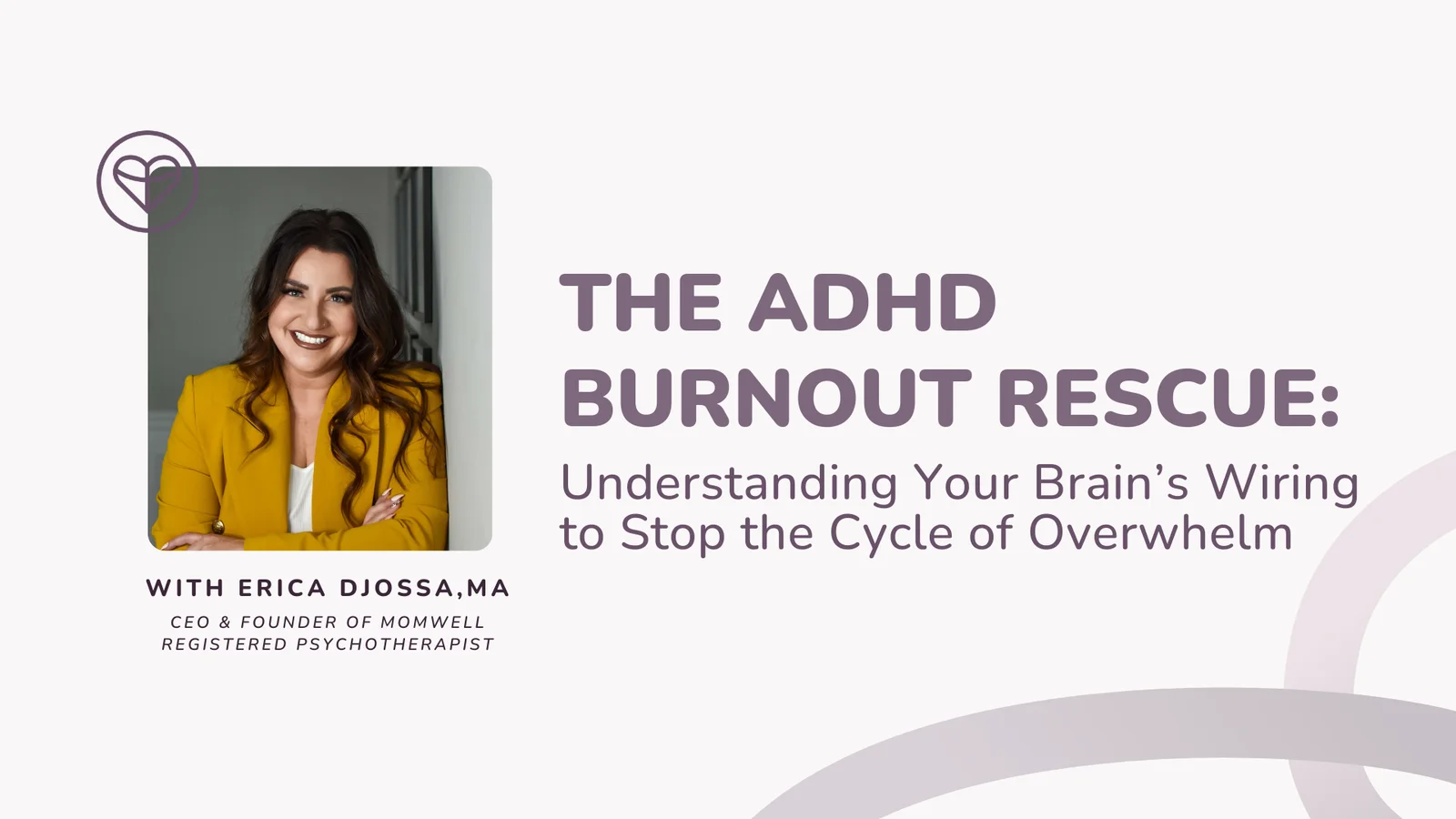
The ADHD Burnout Rescue
Move past the standard productivity tips and into how your brain actually works, so you can stop the cycle of overwhelm. With Erica Djossa.