
Why is motherhood so lonely?
Motherhood can be one of the loneliest seasons of a woman’s life. It is the predictable result of how isolating modern motherhood has become, with long days at home, far-away family, and friendships that quietly fell away.
You can spend a whole day caring for a baby and barely speak to another adult. You can be surrounded by people at a playground or a family dinner and still feel completely unseen.

What it looks like
You might be carrying this if you...
Loneliness in motherhood can be hard to name. You might recognize yourself here if you:

Common questions

Is it normal to feel lonely even when I’m never alone?
Being constantly around small people is not the same as feeling connected, and that gap is exactly where loneliness lives.
- Proximity is not connectionSpending the day with a toddler means a lot of company and very little conversation that fills you up. Your body can register that as loneliness even though you were technically with someone every minute.
- Being needed is not being seenEveryone may want something from you while no one asks how you are. Going unseen in the middle of constant demand is its own particular kind of lonely.
- The feeling is informationThis kind of loneliness points to a specific unmet need for adult connection and mutual understanding. Naming it lets you go looking for the right thing instead of wondering why more people did not fix it.

What if my family lives far away, or I have no village?
It is harder, and the loneliness is real. Family does not have to live far away for the village to be missing, and a village can still be built, though it may look different from the one you pictured.
- The grief is validMissing the hands-on help and easy company you hoped for is a real loss worth acknowledging, whether family is far away or nearby and just not involved. Pretending it is fine tends to deepen the loneliness rather than ease it.
- A village can be assembledNeighbors, a few other moms, a babysitter, a class, or an online group can each become one thread of support. None of them replaces family on their own, but together they can carry real weight.
- Accepting help is part of itBuilding a village means letting people in before everything is tidy and before you feel you have earned it. The moms who feel least alone are usually the ones who let themselves be helped.


How do I cope with loneliness as a mom?
Start by naming it out loud to one person, a partner, a friend, a therapist, instead of carrying it quietly. Then build small, repeated contact, the same park, the same group chat, the same story time, because connection grows from showing up again, not from waiting for it to find you.
Key terms
The language of maternal loneliness
Naming what is happening makes it easier to talk about and easier to change. These are the words that help maternal loneliness feel less like something you are getting wrong and more like the shared, structural experience it is.
- What is maternal loneliness?
- The deep sense of isolation that can come with motherhood, even when you are rarely physically alone. It is a gap between the connection you need and the connection you have, and it is far more common than most moms realize.
- What does having no village mean?
- Raising children without the everyday network of family, neighbors, and community that mothers once relied on. Many moms today carry the load that used to be shared by many hands, which leaves them stretched thin and isolated.
- Why is modern motherhood so isolating?
- The way today’s motherhood is often lived in private homes, far from family, with little built-in community. The isolation is structural, not personal, which is why so many capable, loving moms feel it.
- What is touch starvation and craving adult connection?
- The very human ache for conversation, friendship, and being known by other adults. Caring for small children can leave that need almost entirely unmet, and noticing the craving is the first step toward filling it.

Why do I feel so lonely as a stay-at-home mom?
Because the days are long, repetitive, and often spent with no other adult in the room. That is isolating by design, not because of anything you are doing wrong.
- The contact you need is missingA baby cannot give you conversation, perspective, or the feeling of being known by another adult. Going without that for hours and days at a time would leave anyone feeling cut off, no matter how much they adore their child.
- The work is invisible and unwitnessedSo much of caregiving happens with no one watching and no one to share it with. The lack of an audience can make even the fullest day feel strangely empty and lonely by the time the evening comes.
- It is a real human needCraving adult connection does not mean you are ungrateful or not cut out for this. It means you are a social human being whose need for company is simply not being met right now.
Free tool
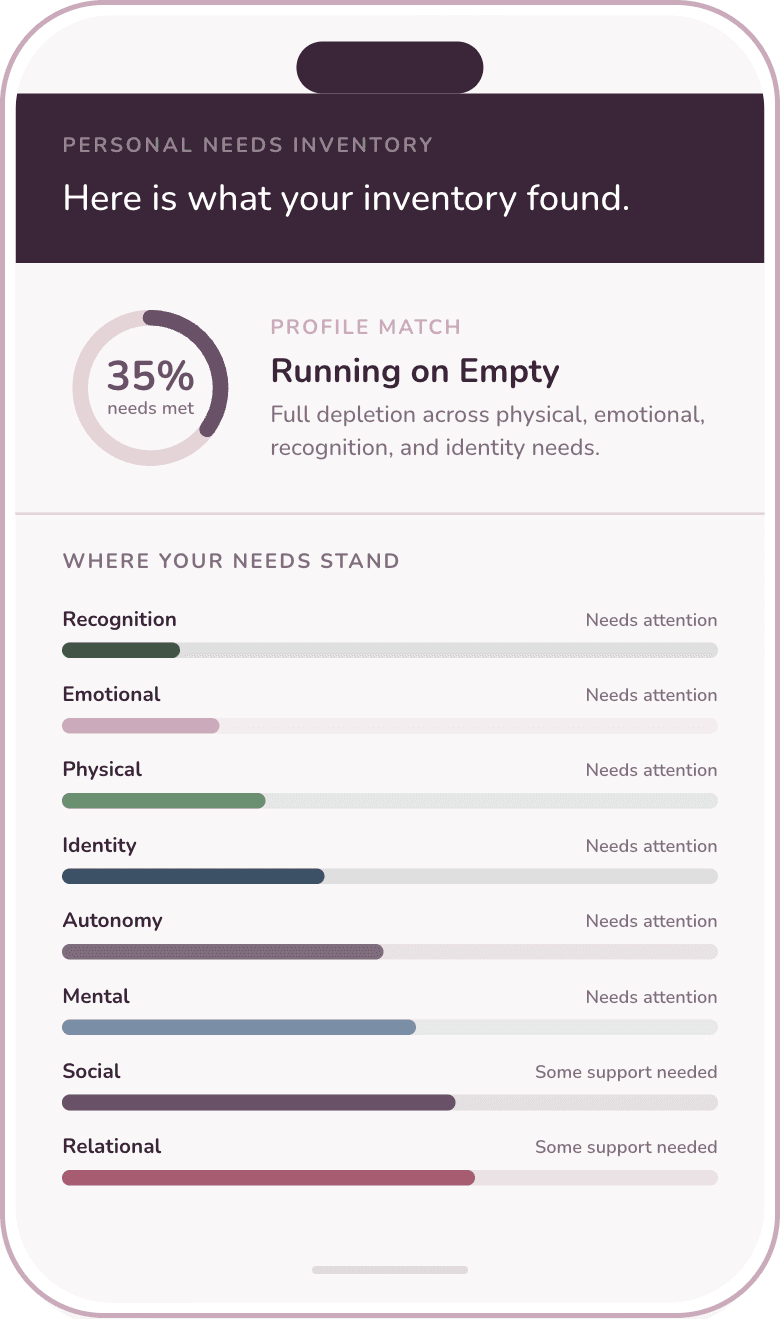
~5 minFreePersonal Needs Inventory
You already know something is off. The Personal Needs Inventory helps you get specific about what it is, across eight areas of your life, so you can finally see where to start.
Connection is one of the needs it maps, and it is one of the first to quietly disappear in a season of isolation. This is the quickest way to see, without judgment, how far your need for adult company has slipped down the list.
How therapy helps
Momwell can help you
Therapy offers a space where you are the one being seen and heard, with a maternal mental health therapist who understands how isolating this season can be and can help you find your way back to connection.

Feel seen and heard
Therapy gives you one relationship where you are not the one holding everyone else together. It is time set aside for your own thoughts, feelings, and needs to be witnessed.
Name what you are missing
Together you can pinpoint exactly which kinds of connection have gone quiet, from friendship to partnership to community. Naming the specific gap makes it far easier to fill.
Rebuild your confidence to connect
Loneliness can make reaching out feel awkward and risky, especially after a long stretch on your own. Therapy can help you practice and rebuild the courage to put yourself back out there.
Set boundaries that protect connection
Sometimes loneliness grows because there is no room left for anything but caregiving. You can work on protecting the time and energy that real relationships require.
Process the grief of a lost village
If you are far from family or watched friendships fade, that loss deserves to be felt rather than minimized. Working through it can free up energy to build what comes next.
Build a village that fits your life
There is no single right way to find your people, and what works will be specific to you. Therapy can help you make a realistic plan to grow the support around you, one step at a time.
How do I make mom friends?
Slowly, and on purpose. Adult friendship rarely just happens anymore, so it helps to treat it like something you build rather than something you wait for.
- Go back to the same placesFamiliar faces become friends through repetition, so the same library story time or neighborhood walk matters more than any one perfect outing. Showing up again is what turns a stranger into someone who saves you a seat.
- Be the one who follows upMost moms are waiting to be invited and assuming everyone else is too busy. A simple “want to grab a coffee this week?” feels vulnerable to send and is almost always a relief to receive.
- Let it be ordinary at firstA real friendship does not need to start with a deep conversation or a packed calendar. A shared complaint at the park or a text about nap schedules is often exactly where the good ones begin.
Free tools and resources
Learn more about connection in motherhood, free and at your own pace.


What clients say
Mom-centered, judgment-free care on your terms.
“I was struggling so much and feeling extremely overwhelmed as a new mother when I discovered Momwell. I thought I was the only one struggling and that there was something wrong with me for not being able to handle it all. After listening to the podcast, I’m feeling so much more like myself again! Motherhood is still hard, but I feel like I can finally breathe and enjoy it. Thank you, Erica!”
“I’d just gotten done crying after yelling at my children for the 100th time that day, feeling like I was a terrible mother, when I found the Mom Rage course. It was so comforting to hear people talking about exactly what I was going through–with NO judgment. I left with the tools I needed to recognize when I’m getting overwhelmed and bring myself back down. Our lives have gotten so much easier–I’m so grateful to Momwell!”