
Why am I grieving as my children grow up?
Grieving as your children grow is real, and it is a form of love. Every stage that ends takes a version of your child, and a version of you, with it. Missing who they used to be does not mean you wish they would stay small forever. It means you loved exactly who they were.
This grief is not ingratitude, and it is not a sign that something is wrong. It is the quiet, bittersweet cost of being deeply attached to a person who is supposed to keep changing. It can sit right alongside the pride and the joy, not instead of them.

What it looks like
You might recognize this if you...
The grief of your children growing up rarely arrives all at once. It surfaces in small, ordinary moments. You might recognize yourself here.

Common questions

Why do I miss my child when they’re right in front of me?
Because you have loved every version of your child, and each one quietly slips away as they grow. Missing them is love, not a failure to enjoy the present.
- You are grieving someone who is still hereEvery stage your child outgrows takes a version of them, and a version of you, with it. You can hold your growing child and still ache for the baby they were, and both feelings can be true at the same moment.
- Nothing went wrong, which makes it hard to nameNo one died and your child is thriving exactly as they should, so this grief has no obvious place to land. That is why it so often gets swallowed and carried quietly, tucked in beside the pride.
- Attention is the root of the acheYou feel the loss of each stage because you were present for it and loved it fully. The missing is proof of how closely you were paying attention, not evidence that you cannot appreciate now.



Is it normal to grieve my kids growing up?
Grieving your children growing up is one of the most common and least talked about parts of motherhood, and feeling it does not mean you are ungrateful or doing anything wrong.

Why does the empty nest feel like losing myself?
Because for years your days and your sense of purpose were organized around being needed. When that winds down, the grief is partly for your children and partly for the version of yourself that mothering them up close created.
- The role shaped your identityActive mothering is not just something you did, it became part of who you are. When the daily need quiets, it is no surprise that your sense of self wobbles along with your schedule.
- An identity shift as big as new motherhoodThe empty nest is an identity shift as significant as becoming a mother in the first place. Feeling unmoored by it does not mean you over-identified with your kids, it means you were deeply invested in them.
- You can grieve and rebuild at onceDiscovering what comes next does not require you to stop missing what was. You are allowed to hold the loss of the role and gently reach for the next version of yourself in the same season.
Key terms
The language of letting them grow
Naming what is happening takes some of its power away. These are the words that make this quiet, ongoing grief easier to see and to talk about.
- What is empty nest syndrome?
- The grief, loss, and disorientation many parents feel when their children leave home and the house goes quiet. It is a commonly used term rather than a formal diagnosis, and feeling it does not mean you raised your children wrong. It means the daily role that shaped your life has changed.
- Why do I grieve as my children grow?
- The bittersweet mourning of each stage as it ends, the baby who became a toddler, the toddler who became a kid, each one loved and then gone. It is a form of love, not ingratitude, and it can live right alongside how proud you are of who your child is becoming.
- What is matrescence in the later years?
- Matrescence is the ongoing process of becoming and being a mother, and it does not stop after the early years. As your children grow and need you differently, your identity keeps shifting too, which is part of why each ending can feel like losing a piece of yourself.
- Is it normal to mourn each stage ending?
- Grieving a loss before it has fully arrived, like aching for the empty nest while your kids are still home, or missing the baby years while holding a growing child. It is a normal response to loving someone who is always, gently, on their way out the door.

Does grieving mean I’m not grateful for my kids?
Grief and gratitude are not opposites. You can be deeply grateful for your children and still mourn the stages that have ended.
- Grief grows out of loveYou only ache for what you treasured. The very fact that you are grieving is evidence of how much you valued every stage, not a sign that you take the present for granted.
- The guilt is the heavier loadThe shame of grieving often does more damage than the grief itself, because it tells you to hide the feeling and carry it in silence. The secrecy is what makes it lonely, not the loss.
- Both things can be true at onceLetting yourself say this is hard and I miss the past, and I love them and this life is what makes the grief bearable. You do not have to choose between mourning and gratitude.
Free tool
~5 minFreePersonal Needs Inventory
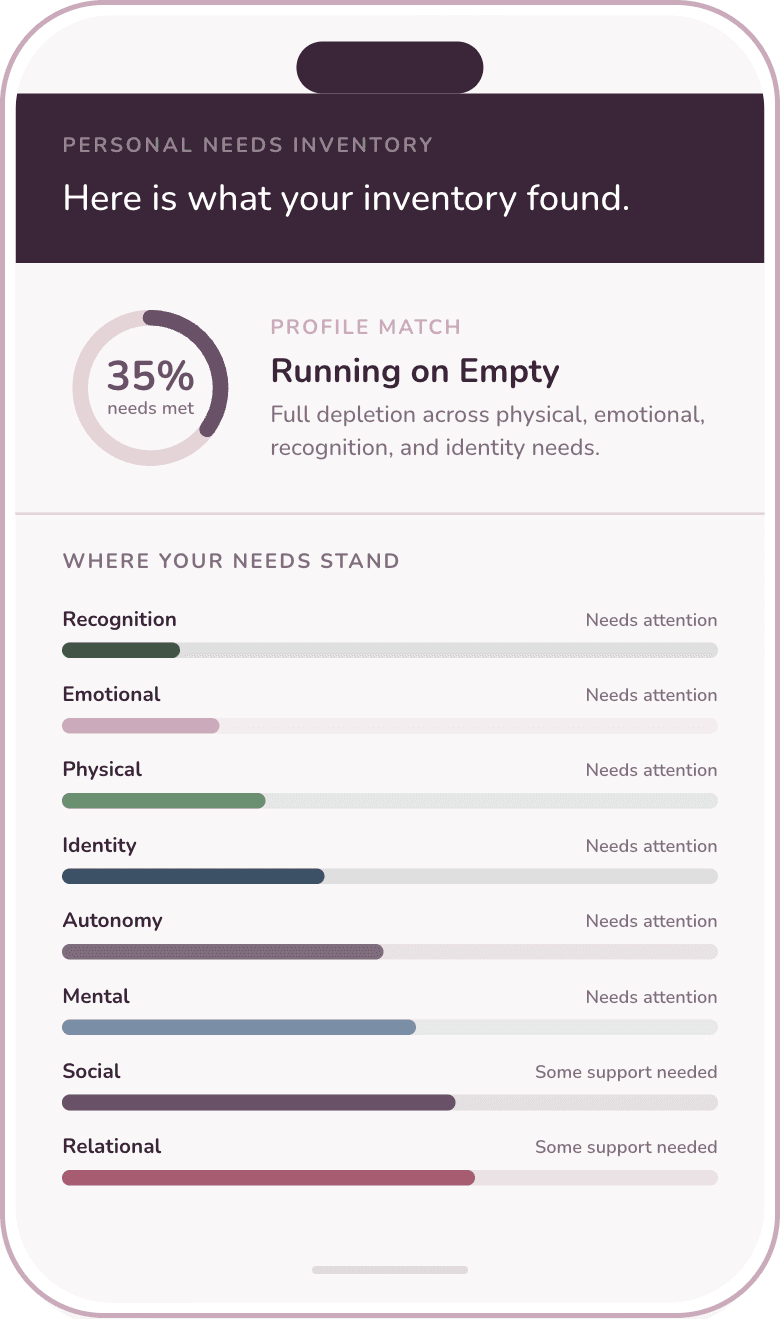
You already know something is off. The Personal Needs Inventory helps you get specific about what it is, across eight areas of your life, so you can finally see where to start.
When so much of your life has been organized around being needed, it is easy to lose track of what you need. As active mothering changes shape, this is a quiet, three-minute way to start finding your way back to yourself.
You leave with a snapshot of where you are depleted and a few concrete places to begin, so the next chapter has a little more of you in it.
How therapy helps
Momwell can help you
Grieving as your children grow is real, and you do not have to make sense of it alone. Our maternal mental health therapists hold space for the love and the loss at once, and help you find your footing as the role changes.

Name the grief without guilt
We give you a space to say the hard, bittersweet thing out loud, and to understand that missing the past does not make you ungrateful for the present.
Hold the love and the loss together
You can grieve who your child used to be and delight in who they are becoming. Therapy makes room for both without making you choose between them.
Move through the empty-nest transition
When the daily need winds down, we help you face the quiet, process the loss of the role, and steady yourself in a season that can feel disorienting.
Reconnect with who you are now
We help you notice what you want and need outside of mothering, and let those parts of you back into a life that finally has room for them.
Redefine closeness as your kids grow
Your relationship with your children is changing, not ending. Together we explore the new, looser shape of staying connected as they become more independent.
Find meaning in the next chapter
Beyond the grief, there is a version of your life still being written. We help you reach toward it at your own pace, without rushing to fill the silence.

How do I cope when active mothering is ending?
Start by giving the grief somewhere to go, then slowly make room for the parts of you the busiest years crowded out. This is not about replacing your kids or rushing to fill the quiet.
- Let the grief be spokenNaming the loss out loud to someone safe is often the first real relief. You do not have to perform only the happy feelings of a season that is bittersweet.
- Make space for who you are nowLet your own needs, interests, and relationships back into a life that finally has room for them. This is not abandoning your role, it is widening it to include you again.
- Stay connected in a new shapeYour relationship with your kids is not ending, it is changing form. Coping means learning the looser, more grown-up version of closeness rather than mourning the old one forever.
Free tools and resources
Start with what you actually need.



What clients say
Mom-centered, judgment-free care on your terms.
“I was struggling so much and feeling extremely overwhelmed as a new mother when I discovered Momwell. I thought I was the only one struggling and that there was something wrong with me for not being able to handle it all. After listening to the podcast, I’m feeling so much more like myself again! Motherhood is still hard, but I feel like I can finally breathe and enjoy it. Thank you, Erica!”
“I’d just gotten done crying after yelling at my children for the 100th time that day, feeling like I was a terrible mother, when I found the Mom Rage course. It was so comforting to hear people talking about exactly what I was going through–with NO judgment. I left with the tools I needed to recognize when I’m getting overwhelmed and bring myself back down. Our lives have gotten so much easier–I’m so grateful to Momwell!”