
What is premenstrual exacerbation (PME)?
Premenstrual exacerbation, or PME, is when an existing condition reliably worsens in the week or two before your period. Conditions like depression, anxiety, ADHD, bipolar disorder, or OCD can all flare in the luteal phase. The flare eases once your period arrives, though the underlying condition stays present through the month.
The key difference from PMDD is what happens the rest of the month. With PME, the underlying condition is present all month long and intensifies premenstrually, so there is no fully symptom-free window. It is real, common, and often missed, because the baseline condition can hide the monthly pattern.

What it looks like
You might be experiencing PME if you...
PME can look different for everyone. You might benefit from therapy if you:

Common questions

Why does my depression or anxiety get worse before my period?
Because an existing condition can flare with the hormonal shifts before your period. The condition does not appear and vanish, it intensifies in the luteal phase and eases again once your period arrives.
- The hormonal shift is a real triggerThe luteal phase, the week or two before your period, brings hormonal changes that can amplify symptoms you already live with. The same depression or anxiety can simply hit harder during that window.
- The underlying condition is there all monthWith PME the underlying condition is there the whole cycle, then worsens before your period. That is what sets it apart from PMDD, where the symptoms lift fully once your period comes.
- It is easy to miss, and not your fault for missing itBecause the baseline condition masks the monthly rhythm, the cyclical pattern often goes unnoticed for years. Naming it is the first step toward support that actually fits.



What is the difference between PMDD and PME?
With PMDD, the mood symptoms appear in the luteal phase and then fully lift after your period, so there are symptom-free days. With PME, an existing condition is present all month and gets worse premenstrually. The clean symptom-free window is the main thing that tells them apart, and a clinician can help you sort out which pattern fits you.


Why has no one mentioned this to me before?
Because PME is under-recognized, not because your experience is unusual. The pattern hides in plain sight when an underlying condition is there all month.
- The baseline condition masks the patternWhen you already live with depression, anxiety, ADHD, or another condition, a monthly flare can look like just another hard stretch. The cycle connection is easy to overlook day to day.
- It often gets mislabeledThe premenstrual spike can be read as the condition simply being unpredictable, or sometimes mistaken for PMDD, when what is actually happening is an existing condition exacerbating on a cycle.
- Naming it changes thingsOnce you can see the pattern, it stops feeling random. You and a clinician can plan support around the window where you need it most.
Key terms
The language of premenstrual exacerbation
These terms get tangled together, but they mean different things. Knowing the difference is what helps you and a clinician find the right support.
- What is premenstrual exacerbation (PME)?
- When an existing condition, such as depression, anxiety, ADHD, bipolar disorder, or OCD, reliably worsens in the luteal phase before your period. The underlying condition is present all month and flares premenstrually, so there is no fully symptom-free window.
- What is the difference between PMDD and PME?
- In PMDD, the mood symptoms appear in the luteal phase and then fully lift after your period, leaving symptom-free days. In PME, an underlying condition is present all month and gets worse premenstrually. The clean symptom-free window is the main thing that tells them apart.
- What is the luteal phase?
- The part of your cycle after ovulation and before your period, usually the last week or two. Hormones shift during this window, and for some people that shift is when an existing condition flares.
- Why does cycle tracking help?
- Logging your symptoms alongside your cycle over a couple of months can reveal a pattern that is hard to see day to day. It gives you and a clinician something concrete to look at, which is often what finally surfaces PME.

Can therapy help with PME?
Therapy can help you see the pattern, prepare for the premenstrual window, and make sure the underlying condition is supported across the whole month.
- Make the pattern visibleA therapist can help you track your cycle alongside how you feel, so the monthly flare becomes something you can anticipate instead of something that keeps blindsiding you.
- Build skills for the hardest windowTogether you can put coping strategies and extra support in place for the luteal phase, so the days that used to undo you have a little more structure around them.
- Tend to the condition underneathBecause PME sits on top of an existing condition, therapy keeps the focus on supporting that baseline all month, and can coordinate with other care when that is the right step.
Free tool
~5 minFreePersonal Needs Inventory
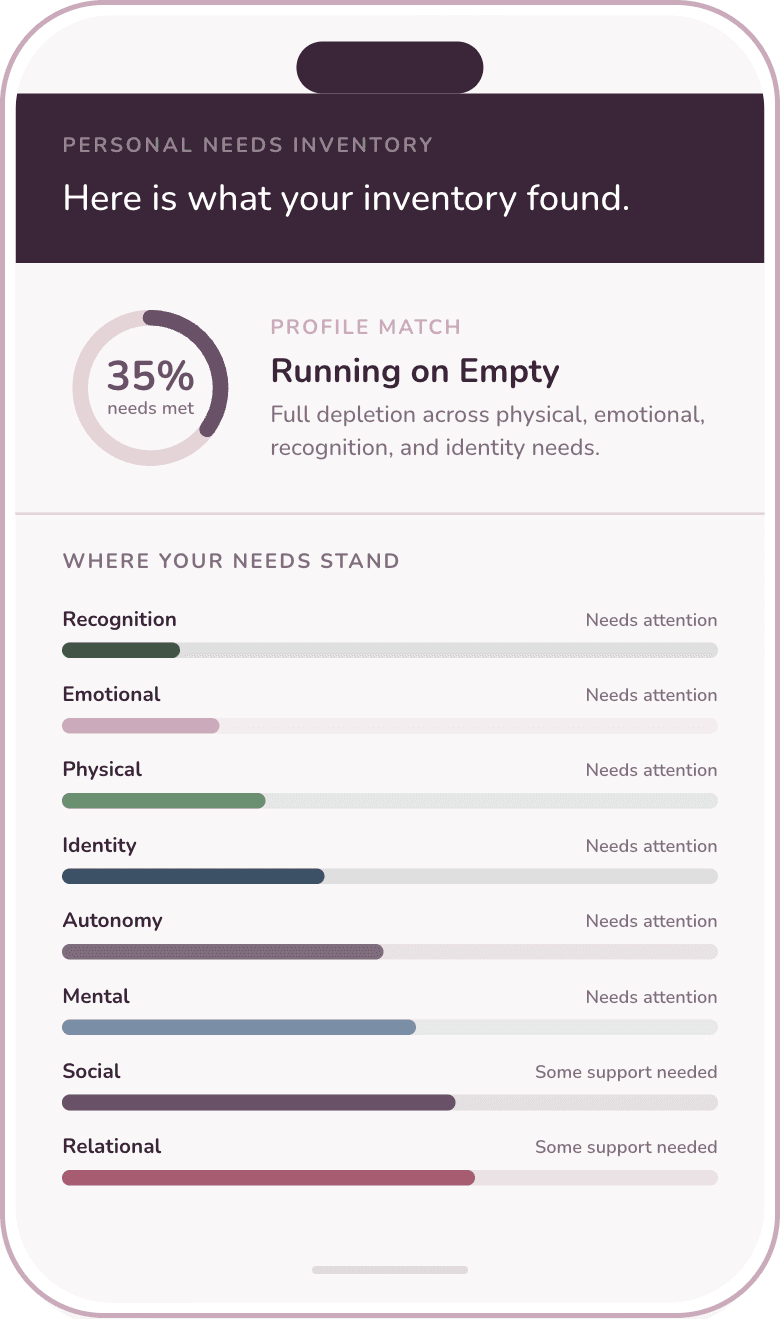
You already know something is off. The Personal Needs Inventory helps you get specific about what it is, across eight areas of your life, so you can finally see where to start.
When an existing condition flares before your period, the days where your needs are most depleted are often the days it hits hardest. Seeing that gap clearly can help you plan support for the window you need it most.
You leave with a snapshot of where you are stretched thin and a few concrete places to start, so the next premenstrual wave has a little more room around it.
How therapy helps
Momwell can help you
Our therapists provide a nonjudgmental space to help you understand your premenstrual pattern, support the condition underneath it, and feel more steady across your whole cycle.

Understand your pattern
Our therapists help you track your cycle alongside how you feel, so the monthly flare becomes something you can see and anticipate instead of something that keeps blindsiding you.
Support the condition underneath
Because PME sits on top of an existing condition, we keep the focus on supporting that baseline all month, not only in the premenstrual window.
Build skills for the luteal window
Together we put coping strategies and extra support in place for the days before your period, so the hardest stretch of your cycle has more structure around it.
Coordinate with your wider care
When it is the right step, a therapist can help you bring the pattern to your other providers, so your care reflects the full picture.
Replace self-blame with self-compassion
We help you let go of the sense that you are failing every month, and see the monthly flare for what it is, a pattern to support rather than a flaw to hide.
Feel more steady across your cycle
With the right support, the same wave that used to undo you each month can start to feel more manageable and less alone.
Free tools and resources
Learn more about PME, free and at your own pace.



What clients say
Mom-centered, judgment-free care on your terms.
“I was struggling so much and feeling extremely overwhelmed as a new mother when I discovered Momwell. I thought I was the only one struggling and that there was something wrong with me for not being able to handle it all. After listening to the podcast, I’m feeling so much more like myself again! Motherhood is still hard, but I feel like I can finally breathe and enjoy it. Thank you, Erica!”
“I’d just gotten done crying after yelling at my children for the 100th time that day, feeling like I was a terrible mother, when I found the Mom Rage course. It was so comforting to hear people talking about exactly what I was going through–with NO judgment. I left with the tools I needed to recognize when I’m getting overwhelmed and bring myself back down. Our lives have gotten so much easier–I’m so grateful to Momwell!”