
Why is being a stepmom so hard?
Stepping into a blended family often comes with invisible expectations, emotional landmines, and unspoken pressure to “just fit in.” Unlike biological parents, stepmoms are rarely offered grace or guidance, yet you’re still carrying a deep emotional load.

What it looks like
You might benefit from therapy if you...
Stepmom life can be emotionally complex. You might benefit from therapy if you:

Common questions

Does struggling as a stepmom mean something is wrong with me?
The hard parts of stepmom life are about the role itself, not about you not being good enough for it.
- The role is complexStepmotherhood asks you to build trust, navigate loyalties, and find your place all at once. Finding that hard is a response to how much the role demands, not a sign that something is wrong with you.
- You were handed no mapUnlike biological parents, stepmoms are rarely offered grace or guidance for any of it. You are doing emotionally demanding work without the recognition or support that would make it feel possible.
- You are not the only oneSo many stepmoms feel overwhelmed, invisible, or unsure of their place and assume they are alone in it. You are not, and naming that out loud is often where the weight starts to lift.



Am I even allowed to have boundaries?
You’re allowed to protect your energy and mental health, and doing so is what makes connection last.
- With the kids: a role you can sustainYou don’t have to act like a second mom overnight, or absorb every behavior as if you caused it. You’re allowed to define the relationship you can actually offer your stepchildren and let it grow at its own pace.
- With your partner and the co-parentYou can ask your partner to lead on discipline and the hard conversations with their kids, and to back you up. You can also step back from the ex and the co-parenting logistics that aren’t yours to carry.
- With yourself: your own time and needsProtecting time to refill your own cup isn’t selfish, it’s what keeps you from burning out. A boundary guards the energy you actually have to give, so the connection you build can last.


Should I love my stepchildren right away?
Love and connection take time. It’s okay if those feelings don’t happen immediately, or if they look different than what you expected.
Key terms
The language of stepmom life
Naming what is happening takes some of its power away. These are the terms that make stepmom life easier to see and to talk about.
- What is a stepmom?
- A stepmom, or stepmother, is a woman parenting children who are not biologically hers, usually through marriage or partnership. The role carries real responsibility and deep emotional investment, often without the recognition or guidance that biological parents receive.
- What is a blended family?
- A blended family forms when partners bring children from previous relationships into one household. It blends different histories, loyalties, and routines, which is why it so often takes patience and time to settle rather than falling into place right away.
- What is the invisible load of a blended family?
- The invisible load is the unseen emotional and mental work of holding a blended family together, anticipating needs, smoothing transitions, and managing everyone’s feelings. For stepmoms it is rarely named or shared, which is part of what makes it so heavy.
- What are boundaries in a blended family?
- Boundaries are the limits that protect your energy and mental health inside the family. They are not a wall between you and your stepchildren; they make connection more sustainable by keeping you from running on empty.

If I were doing this right, would I still feel resentful?
Resentment is a signal, not proof that you’re failing at this.
- Resentment is informationIt’s easy to read resentment as evidence you’re doing stepmom life wrong. It’s closer to a dashboard light, a sign that something needs attention rather than a verdict on your worth.
- It usually points to a needResentment often grows where your own needs are going unmet and unseen. Naming what is missing tends to do more than trying harder to feel grateful.
- It can be worked throughYou don’t have to white-knuckle resentment into silence. It can be unpacked and worked through in therapy, with support that is finally centered on you.
How therapy helps
Momwell can help you
Becoming a stepmom is one of the most emotionally complex parenting roles, yet it’s often overlooked. Therapy gives you a space that’s finally centered on you.

Understand your role
Our therapists help you process the complexity of stepmom life, so you can stop questioning your place and start feeling more grounded in it.
Set healthy boundaries
We’ll work with you to define limits that protect your mental and emotional wellbeing, without sacrificing connection.
Navigate co-parenting dynamics
Momwell therapists offer tools to help you navigate interactions with ex-partners, parenting conflicts, and loyalty binds, so you can stay grounded without losing yourself in the process.
Address guilt and resentment
We create space for your full emotional experience, helping you move through guilt, resentment, and shame with compassion, not judgment.
Rebuild connection with yourself and others
You’ll learn to reconnect with your own identity while building more authentic relationships with your partner and stepchildren.
Protect your peace
We’ll help you identify what drains you and what restores you, so you can create a version of stepmom life that feels sustainable and supported.
Does anyone else feel this way?
Many stepmoms feel overwhelmed, invisible, or unsure of their place, even when no one says it out loud.
- The silence is the trapStepmom struggles are rarely talked about openly, which makes each stepmom assume she’s the only one. The isolation is often heavier than the actual challenges underneath it.
- Feeling invisible is commonCarrying real emotional work without recognition leaves many stepmoms feeling unseen in their own homes. That feeling is widely shared, even though it’s seldom named.
- Support is availableYou don’t have to keep figuring this out alone. Momwell’s therapists offer a space built for exactly this, centered on you rather than everyone else.
Free tools and resources
Free tools to help you see the load you’re carrying.
Free tool
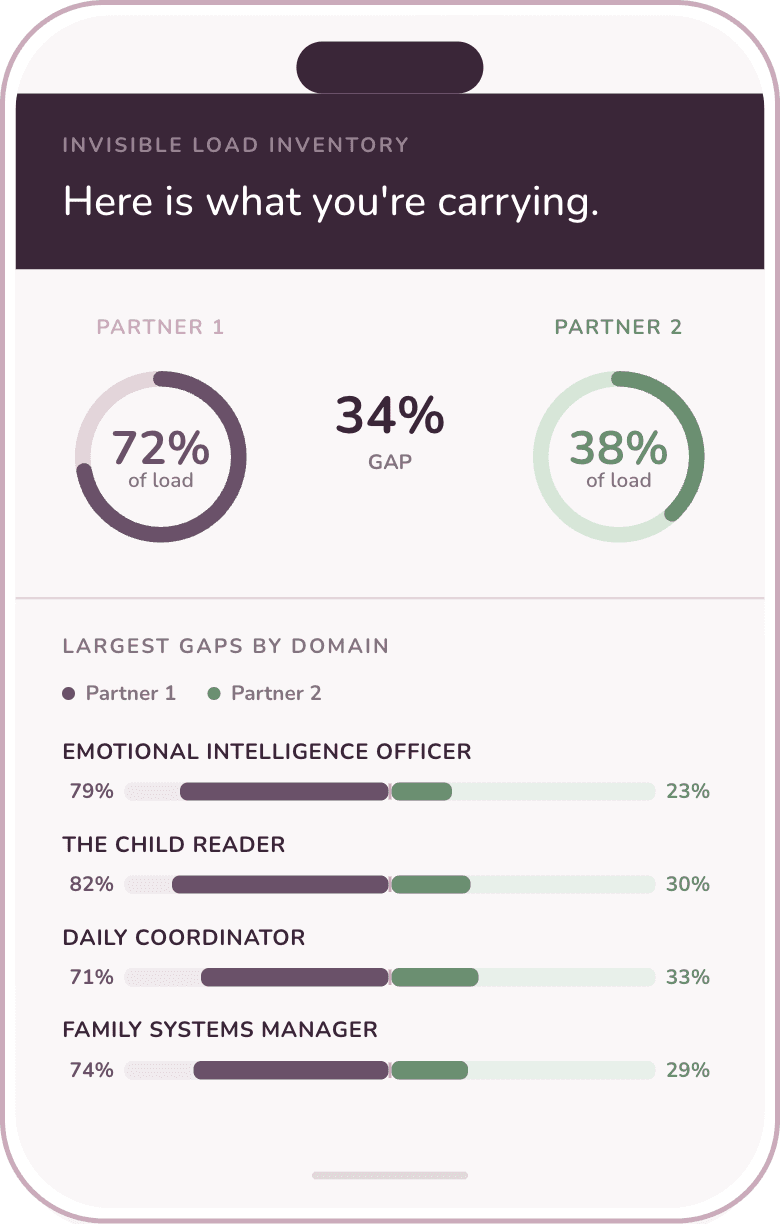
63 questions, 9 domains5 minsAlways freeThe Invisible Load Inventory
You already know something is off. Now you can both see it.
This inventory gives both of you something concrete to look at. Not to assign blame, but to finally be looking at the same thing.
Each partner completes the inventory independently. Your results map who is carrying what across all 9 domains, both perspectives, side by side.


What clients say
Mom-centered, judgment-free care on your terms.
“I was struggling so much and feeling extremely overwhelmed as a new mother when I discovered Momwell. I thought I was the only one struggling and that there was something wrong with me for not being able to handle it all. After listening to the podcast, I’m feeling so much more like myself again! Motherhood is still hard, but I feel like I can finally breathe and enjoy it. Thank you, Erica!”
“I’d just gotten done crying after yelling at my children for the 100th time that day, feeling like I was a terrible mother, when I found the Mom Rage course. It was so comforting to hear people talking about exactly what I was going through–with NO judgment. I left with the tools I needed to recognize when I’m getting overwhelmed and bring myself back down. Our lives have gotten so much easier–I’m so grateful to Momwell!”