
What is emotional regulation?
Emotional regulation is the ability to manage your emotions, even in the midst of stress, frustration, or chaos. It’s about staying grounded and responding thoughtfully rather than reacting impulsively.
If you find yourself snapping, shutting down, or spiraling in guilt after big emotions, that is a nervous system asking for skills it was never taught.

What it looks like
You might be struggling with emotional regulation if you...
Dysregulation can show up in different ways. Any of these can be part of it:

Common questions


How do I regulate my emotions as a mom?
You regulate your emotions by noticing them early and giving your nervous system a way to settle, and those are skills you can build.
- Catch it in your body firstThe clenched jaw, the rising heat, the held breath usually arrive before the snap does. Learning your own early signals buys you the half-second of space where a different response becomes possible.
- Settle before you respondA slow exhale, a hand on your chest, or naming the feeling out loud tells your body it is safe enough to come down. These are small, repeatable tools, not grand gestures, and they work because you can reach for them mid-moment.
- Practice when it’s calm, out of the momentRegulation is a skill that strengthens with reps, so the easiest time to build it is before the meltdown, not during it. Therapy gives you tools matched to your triggers and a place to practice them until they hold under pressure.


Shouldn’t I be able to stay calm all the time?
Staying calm every moment isn’t realistic, it is an unattainable target that only sets you up to feel like you are failing. The real goal is to reduce the intensity of your reactions, how long they last, and how often they take over, so you can stay grounded and respond thoughtfully more of the time.


Can therapy actually help me stop being so reactive?
Reactivity isn’t a fixed trait, it’s a nervous system doing its best without the right tools, and those tools can be learned.
- A flooded nervous system has its reasonsA nervous system that floods quickly was usually shaped by stress, history, or sheer depletion, not by a lack of willpower. That means the answer is tools and practice, not trying harder to be someone you’re not.
- The tools are built for the hard moment itselfTherapy teaches evidence-based strategies to help you calm your nervous system and regulate even during meltdowns, when you need them most. They are designed for the actual hard moment, not just for the calm after it.
- Confidence grows with the toolsAs your regulation toolbox fills, the moments that used to flood you start to feel survivable. That steadiness ripples outward, creating more peace for you and for your family.
Key terms
The language of emotional regulation
Naming what is happening takes some of its power away. These are the terms that make big emotions easier to see, and easier to work with.
- What is emotional dysregulation?
- When feelings get too big to manage in the moment and spill over as snapping, shutting down, or spiraling. It is a nervous system without the right tools yet, not a flaw in you.
- What is nervous system regulation?
- The skill of helping your body settle from stress back toward calm, so you can respond instead of react. It can be learned and practiced, even if no one ever taught it to you.
- What is the window of tolerance?
- The zone where you can feel a hard emotion and still stay grounded and present. When the demands of motherhood push you past its edges, you tip into flooding or shutting down.
- What is co-regulation?
- Borrowing calm from another steady person, the way your child borrows it from you. Your own regulation is what lets you offer that steadiness, which is why filling your own cup matters.

If I yell or lose it, have I damaged my child?
Losing your temper doesn’t erase a loving relationship or make you a bad parent. What matters most is what comes after.
- One hard moment doesn’t define the bondEvery parent loses their cool, and a single outburst doesn’t undo years of love and care. What your child carries forward is the overall pattern of your relationship, not the worst thirty seconds of it.
- Repair is what your child remembersComing back afterward to reconnect, name what happened, and make it right is how children learn that big feelings are survivable. Therapy helps you learn to repair so the rupture becomes a lesson instead of a wound.
- You teach by modelingShowing healthy emotional accountability is one of the most powerful things you can give your child. They learn how to handle their own hard moments by watching how you handle yours.
Free tool
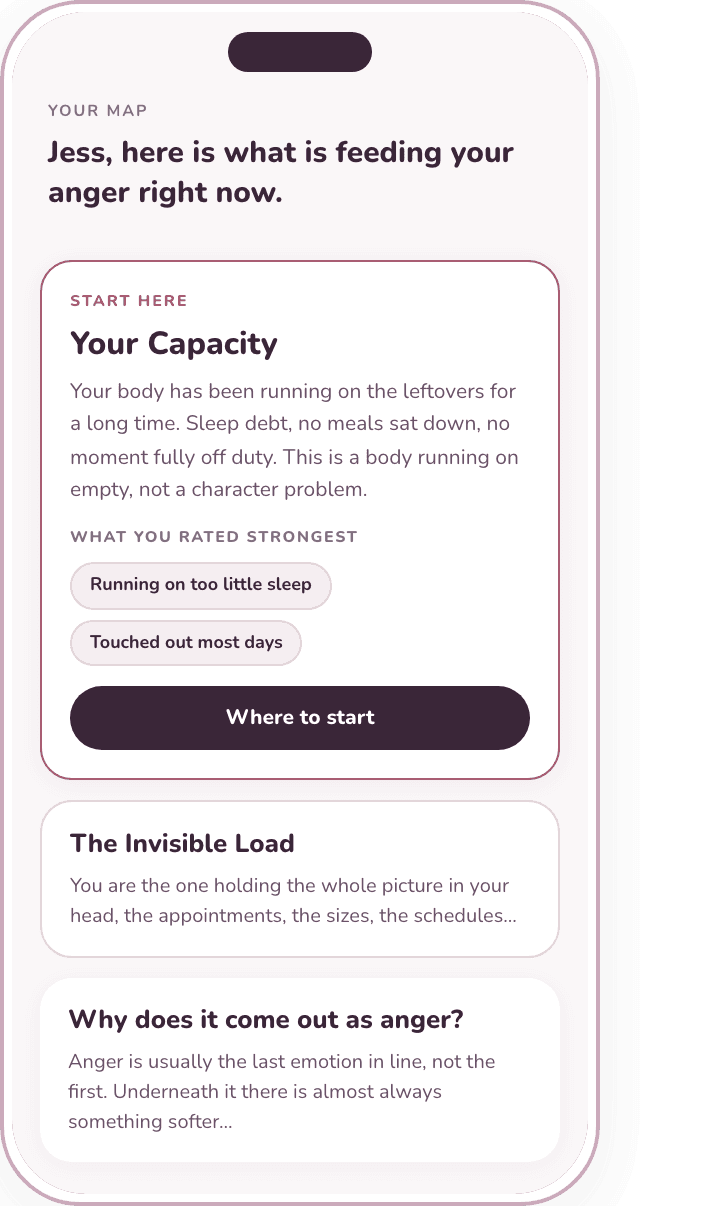
~5 minFreeThe Mom Rage Map
You love your kids, and you still find yourself snapping over the small stuff, then sitting in the guilt afterward. The Mom Rage Map shows you what is actually fueling that anger across nine areas of your life, not just how to hold it in.
It shows you what is quietly draining your capacity before you reach for the skills, so you know what you are actually regulating against, with one place to start.
How therapy helps
Momwell can help you
We’ll help you uncover the root causes of your emotional reactions, so you can recognize patterns and respond with intention.

Understand your triggers
We’ll help you uncover the root causes of your emotional reactions, so you can recognize patterns and respond with intention.
Build your regulation toolbox
We teach evidence-based strategies to help you calm your nervous system and regulate in real time, even during meltdowns.
Repair after rupture
Learn how to repair after emotional moments, reconnect with your child, and model healthy emotional accountability.
Replace shame with compassion
We’ll work together to challenge the guilt and self-blame, empowering you to approach yourself with kindness.
Feel more in control
As your regulation tools grow, so does your confidence. We support you in creating more peace, for you and your family.
Break intergenerational patterns
If you didn’t grow up with calm, attuned parenting, it’s okay. We help you become the parent you want to be.

Why does everyone else seem to stay calm just fine?
Because what looks effortless from the outside rarely is. Comparison only adds another layer of shame to carry.
- Calm is often a highlight reelYou only see other parents in their public, composed moments, not in the car after drop-off or behind a closed bathroom door. Measuring your hardest moments against their visible best is a contest you can never win.
- More common than moms admitSo many parents are quietly struggling with the same flooding and guilt, convinced everyone else has it figured out. The secrecy is what makes it feel unique, when it is actually one of the most common experiences in motherhood.
- Kindness loosens the gripTherapy gives you a space to challenge the self-blame and meet yourself with the same compassion you’d offer a friend. From that softer place, regulation gets easier, because you’re no longer fighting yourself on top of everything else.
Isn’t this just who I am?
Patterns can feel permanent, especially if you didn’t grow up with calm, attuned parenting, but they can change.
- You react the way you were raised to reactThe way you react under stress was largely shaped by what you lived through and what was modeled for you. What was learned can be unlearned, and new responses can be built in its place.
- You can break the cycleIf you didn’t grow up with calm, attuned parenting, you may never have been handed these skills. Therapy helps you break intergenerational patterns so the buck stops with you, rather than passing forward what you inherited.
- You get to choose who you becomeBuilding regulation skills lets you become the parent you actually want to be, on purpose. The version of you that you’re reaching for is not a fantasy, it’s a practice you can grow into.
Free tools and resources
Learn more about emotional regulation, free and at your own pace.



What clients say
Mom-centered, judgment-free care on your terms.
“I was struggling so much and feeling extremely overwhelmed as a new mother when I discovered Momwell. I thought I was the only one struggling and that there was something wrong with me for not being able to handle it all. After listening to the podcast, I’m feeling so much more like myself again! Motherhood is still hard, but I feel like I can finally breathe and enjoy it. Thank you, Erica!”
“I’d just gotten done crying after yelling at my children for the 100th time that day, feeling like I was a terrible mother, when I found the Mom Rage course. It was so comforting to hear people talking about exactly what I was going through–with NO judgment. I left with the tools I needed to recognize when I’m getting overwhelmed and bring myself back down. Our lives have gotten so much easier–I’m so grateful to Momwell!”