
What is the invisible load, or mental load, of motherhood?
The invisible load, also called the mental load, is everything required to run a family that has no task card, no schedule, and no one assigning it. It is the mental and emotional work of anticipating needs, remembering details, managing relationships, and holding the whole of family life in your head at once.
It is not just the to-do list. It is knowing what the to-do list should be.
Every task your family can see is the tip of an iceberg. Underneath sit the noticing, researching, planning, and monitoring that nobody ever told us counted as work.

What it looks like
The work no one sees. The weight that never gets put down.
You may be carrying the invisible load if these feel familiar.

Common questions

Why do moms end up carrying most of the invisible load?
In different-sex couples, this weight overwhelmingly falls to moms, even when both partners work full-time.
- We fall into defaults we never choseWithout a plan to share the labor, couples slip into traditional gender norms without realizing it. Partners often report it is split evenly while moms report carrying more, and when the mental labor is itemized, moms are carrying it.
- Intensive mothering raises the barWe parent in an era that says “good moms” are self-sacrificers who give every ounce of energy to their children, so we are unlikely to let the labor go.
- Expertise becomes a trapThe knowledge gap starts before conception and widens through maternity leave, when moms log thousands of hours of practice. You might do it better, but only because you are the one already doing it.



Isn’t the invisible load just part of being a mom?
It’s common, but it isn’t yours to carry alone. The load stays unbalanced as long as it stays unspoken, and naming it is the first step to sharing it.


We divided up the chores. Why am I still so exhausted?
Because dividing the chores divides the physical labor, not the thinking work underneath it.
- The task gets shared, the thinking does notYou take the cooking, your partner takes the shopping, then they ask you to make the list, text from the store about substitutions, and ask where things go at home. The physical work was split. The cognitive labor still fell to you.
- Mental labor never clocks outIt is not a one-and-done task. The anticipating, planning, and managing stick with you, intruding on your free time and even your paid work time.
- It rarely feels finishedWorking constantly while feeling like nothing ever gets “done” is the exhaustion so many moms cannot explain.
Key terms
The language of the invisible load
Naming this labor is the first step to sharing it. As long as it stays undefined, it stays unbalanced. Here are the terms that make it visible.
- What is the invisible load, or mental load?
- The mental and emotional labor of running a family: the planning, organizing, decision-making, and constant managing of the moving pieces that keep a household functioning. The invisible load and the mental load mean the same thing, and it is called invisible because it is hard to see, even for the person carrying it.
- What is cognitive labor?
- The mental work that accompanies a task: anticipating, researching, planning, and managing. Before a child gets dressed, someone tracked the sizes, noticed the season change, and bought what was missing. Unlike physical tasks, it is never really done.
- What is emotional labor?
- Anticipating and tending to the family’s emotional needs: reading the room, noticing when a child is starting to struggle, and regulating your own stress to keep everyone calm.
- What is a default parent?
- The parent who is asked or assumed first, for tasks, logistics, and emotional care alike. The one the kids walk up to even when both parents are in the room. The role usually falls to moms, without discussion and without a plan.
How do I explain the invisible load to my partner?
Start by making the mental load visible, to yourself first and then to your partner. For a lot of couples the gap is more about visibility than willingness, and you cannot share what neither of you can clearly see.
- Write one task out, start to finishPick one task that weighs you down, like doctor’s appointments or packing lunches, and map the anticipating, planning, and monitoring underneath it. What looks like one thing to your partner is often dozens of mental steps on paper.
- Bring it up on a calm dayHave the conversation outside the heated moment, because an argument over one left-out dish never captures the real load. The weight comes from the volume, from it falling to you by default, and from losing say over your own time.
- Separate your partner from the problemYour partner is not the enemy, the system is. In many homes they do not see the mental labor or know where to start sharing it, and blame gets you defensiveness where clarity gets you a teammate.
Free tool
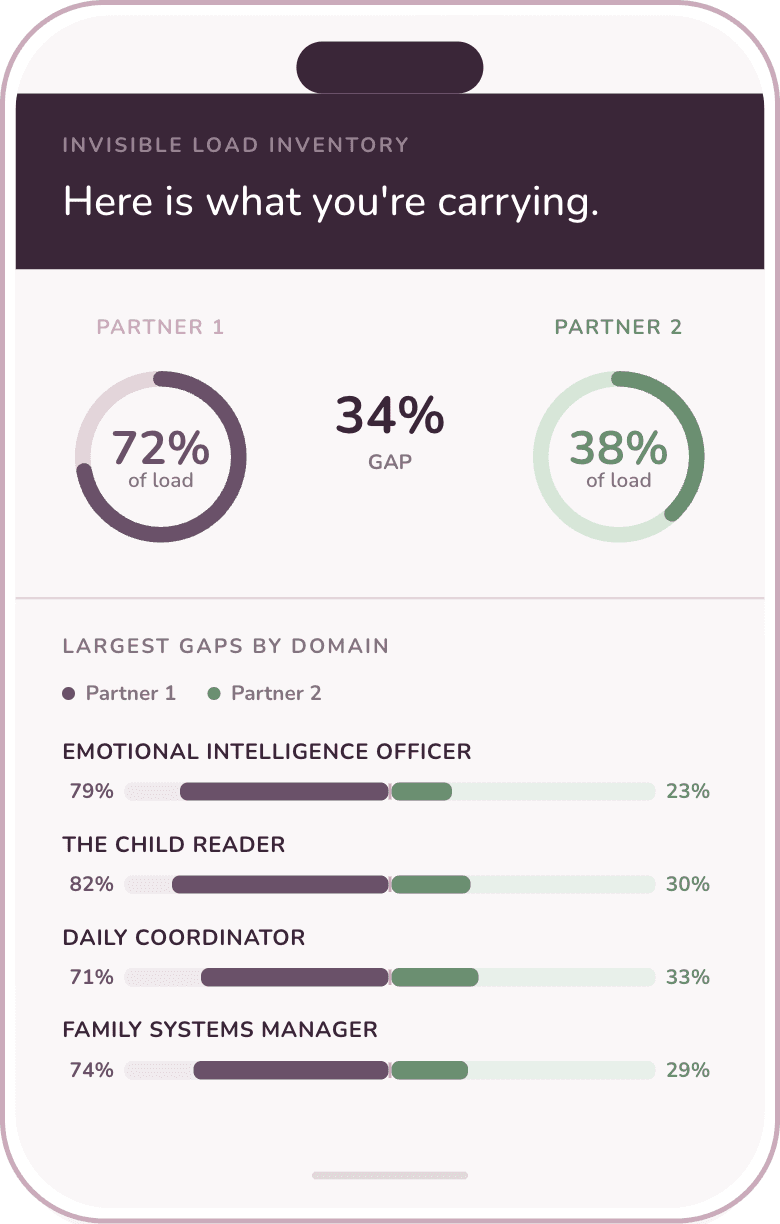
63 questions, 9 domains5 minsAlways freeThe Invisible Load Inventory
You already know something is off. Now you can both see it.
This inventory gives both of you something concrete to look at. Not to assign blame, but to finally be looking at the same thing.
Each partner completes the inventory independently. Your results map who is carrying what across all 9 domains, both perspectives, side by side.
How therapy helps
How therapy helps with the invisible load
The real problem often goes beyond what your partner is or isn’t doing, and even beyond the distribution of labor itself, to a need to be seen, acknowledged, and understood. If you want to break out of the patterns and change the way the labor is shared, you have to learn to see those needs.

Reduce stress and overwhelm
We’ll guide you in creating a plan to manage the mental load of motherhood and access the support you need to feel more grounded.
Unpack the beliefs that create the load
Until we address the internal beliefs that tell us we need to carry all the weight to be “good moms,” redistributing labor runs into major hurdles. Therapy is where that unlearning happens.
Communicate needs instead of criticism
When we struggle with invisible labor and don’t know how to explain it, it can come out as criticism and blame and take a toll on the relationship. Therapy helps you find the language for what you’re really feeling and needing.
Move from scorekeeping to problem-solving
When both partners can see the same picture, the conversation shifts from competing perceptions to shared language, and labor can actually be redistributed.
Can the invisible load actually be shared?
It can, but not with a chore chart alone.
- Charts slip without the deeper workCouples who divide labor without examining the role of gender and socialization tend to slide back into old patterns, no matter how many lists or rotations they build.
- Retire “it’s easier if I just do it myself”It isn’t easier when you are doing double time on mental labor, and it deprives your partner of the practice they need to grow from novice to expert.
- When partners share it, everyone benefitsIt reduces pressure and overwhelm on moms and empowers partners to make decisions and parent with confidence.
Free tools and resources
The invisible load doesn’t get lighter until someone can finally see it.
 ArticleThe Mental Load of MotherhoodHow to Address the Imbalance of Household Labour
 ArticleHow Partners Can Share in the Invisible Load and Reduce Mental Labour for Moms
 ArticleBreaking Out of the Default Parent RoleHow to Communicate with Your Partner and Change Patterns
Guide
$12.99 USDGuide: How to Explain the Mental Load to Your Partner
Do you feel like talking about the mental load only makes things worse? If you’re drowning in the invisible labor and not sure how to explain it to your partner, you’re not alone.
This practical guide is designed to help you open the conversation, communicate productively, and shine a light on the impact the mental load has on you so you and your partner can begin sharing labor in a different way.
28 pages. Proceeds help bring therapy support to more moms and increase accessibility.
What clients say
Mom-centered, judgment-free care on your terms.
“I was struggling so much and feeling extremely overwhelmed as a new mother when I discovered Momwell. I thought I was the only one struggling and that there was something wrong with me for not being able to handle it all. After listening to the podcast, I’m feeling so much more like myself again! Motherhood is still hard, but I feel like I can finally breathe and enjoy it. Thank you, Erica!”
“I’d just gotten done crying after yelling at my children for the 100th time that day, feeling like I was a terrible mother, when I found the Mom Rage course. It was so comforting to hear people talking about exactly what I was going through–with NO judgment. I left with the tools I needed to recognize when I’m getting overwhelmed and bring myself back down. Our lives have gotten so much easier–I’m so grateful to Momwell!”