
What is resentment in motherhood?
Resentment in motherhood is the slow-building anger that grows when you carry far more than your share and feel unseen doing it. It is what happens when the imbalance at home goes unacknowledged for long enough that frustration hardens into something heavier.
It is not a sign that you are a bad partner or a bad mom, and it does not mean you love your family any less. It is a signal pointing at a real inequity and an unmet need, both of which deserve to be named rather than swallowed.

What it looks like
When frustration hardens into something heavier
Resentment is more than a bad mood. It is anger that has built up over time and has nowhere to go. You might be carrying it if you:

Common questions

Why do I resent my partner so much?
Most often, because a real imbalance has gone unseen for too long. Resentment is a natural response to that inequity, not a flaw in you.
- It grows out of a real imbalanceWhen you carry the majority of the work, the planning, and the emotional labor while your partner moves through the day with more freedom, resentment is a reasonable response. The feeling is pointing at the inequity, not making one up.
- It is rarely about a single choreThe flashpoint might be the dishes, but the ache underneath is bigger than that. It is feeling like you cannot rest the way they can, like your effort goes unnoticed, and like no one is coming to even it out.
- Naming the inequity is where change startsYou cannot solve an imbalance that stays unspoken and invisible. Putting words to what is actually uneven is the first move out of quiet resentment and into a conversation that can shift it.



Is it normal to feel resentful as a mom?
Resentment is one of the most common things moms describe when the load at home is uneven and unacknowledged, and it usually says more about the situation than about you.
- It does not make you ungratefulYou can love your family deeply and still feel resentment about how the work is split. Feeling it makes you a person responding to a situation that is not fair, not a bad partner or an ungrateful one.
- What you do with it is what mattersThe question is never really whether the resentment is there, it usually is. The question is what happens next, because resentment left to sit and resentment brought into the open lead to very different places.
- Unspoken, it hardens into distanceWhen resentment has nowhere to go, it quietly cools the relationship and widens the gap between you. Brought into the open and understood, that same feeling can become the thing that finally shifts the dynamic.


How do I stop resentment from damaging my relationship?
It helps to separate your partner from the problem. Your partner is not the enemy, the system is.
- Separate your partner from the problemJust like you, your partner is carrying a lifetime of gender norms and expectations they did not choose. Often the issue is not that they refuse to share the load but that they cannot yet see it.
- Move from scorekeeping to clarityTallying who did what keeps you both stuck in competing perceptions instead of solving anything. Naming the specific imbalance and making the invisible load visible gets you both looking at the same thing.
- Ask, instead of waiting to be noticedResentment grows in the gap between what you need and what you wait silently to be offered. Asking for something concrete gives your partner a way to respond, and gives you a result instead of more proof.
Key terms
The language of resentment
Naming what is happening takes some of its power away. These are the terms that make resentment in motherhood easier to see and to talk about.
- What is resentment in motherhood?
- The slow-building anger that grows when you carry far more than your share and feel unseen doing it. It is a signal pointing at a real inequity and an unmet need, not a verdict on you as a partner or a mom.
- What is the invisible load?
- The unseen planning, remembering, and emotional labor of running a family that rarely gets named or shared. Because it is invisible, it often goes unacknowledged, which is exactly where resentment takes root.
- What is scorekeeping in a relationship?
- Tracking and tallying who did what, which tends to surface when the load feels unfair and unspoken. It can feel like proof, but it usually keeps both partners stuck in competing perceptions instead of solving the imbalance.
- What are unmet needs?
- The things you are not getting that you need, to be seen, supported, rested, or to have the load shared. Resentment is often the alarm, and the unmet need underneath it is the signal worth listening to.

What is my resentment trying to tell me?
Resentment is information. Underneath it is almost always an unmet need and a value of yours that is being stepped on.
- The anger is the alarmResentment is loud because it is trying to get your attention, not because something is wrong with you. The feeling itself is the alarm, and the need underneath it is the signal worth listening to.
- Underneath is an unmet needTo be seen, to be supported, to rest, to have the load actually shared. Naming that need turns a vague, heavy frustration into something specific you can understand and act on.
- A named need can be answeredWhen you can say the need instead of just the frustration, you can ask your partner for something concrete they can respond to. Therapy can help you find that need under the resentment and put it into words.
Free tool
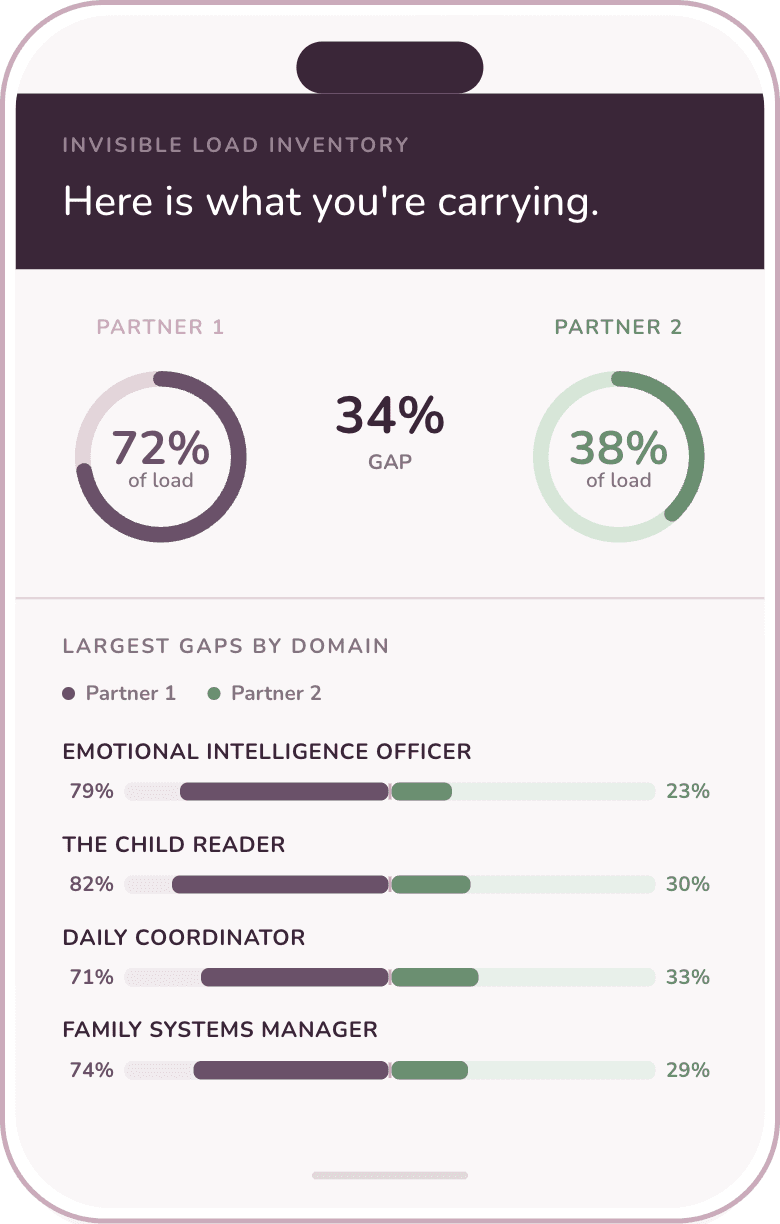
63 questions, 9 domains5 minsAlways freeThe Invisible Load Inventory
You already know something is off. Now you can both see it.
This inventory gives both of you something concrete to look at. Not to assign blame, but to finally be looking at the same thing.
Each partner completes the inventory independently. Your results map who is carrying what across all 9 domains, both perspectives, side by side.
How therapy helps
How therapy helps with resentment
Resentment rarely fades by trying to feel less of it. It eases when the inequity underneath it gets named, the unmet need gets met, and the conversation moves from scorekeeping to something that actually changes the load. A maternal mental health therapist can help you get there.

Understand what the resentment is signaling
We help you trace the resentment back to the real inequity and the unmet need beneath it, so you know what you are actually fighting for.
Communicate needs instead of criticism
When resentment comes out as criticism and blame, it strains the relationship. Therapy helps you find the language for what you are really feeling and needing.
Reduce stress and overwhelm
We’ll guide you in creating a plan to manage the mental load of motherhood and access the support you need to feel more grounded.
Move from scorekeeping to problem-solving
When both partners can see the same picture, the conversation shifts from competing perceptions to shared language, and the load can actually be redistributed.

Is feeling this resentful just part of motherhood?
Some frustration comes with carrying a lot, but a steady, growing resentment is not a price you simply have to pay.
- Some frustration is normalAny season of carrying a heavy load comes with hard days and short tempers. That kind of frustration comes and goes, and it is not the same as resentment that settles in and stays.
- Lingering resentment is differentA steady resentment that colors how you feel about your partner or your days is its own thing. Being told it is just part of motherhood keeps a lot of moms quiet and alone with it.
- It is a sign to take seriouslyResentment that lingers usually means something in the balance of support and load needs to change. That is worth taking seriously and getting help with, not a verdict on your relationship or your character.
Free tools and resources
See what is really driving the resentment, free and at your own pace.
 ArticleDividing Labour Fairly in the HomeRedistributing the Mental Load of Motherhood
 ArticleUnpacking Gender Norms Part 2How to Share the Mental Load: Breaking Away From Norms and Redistributing Labour
 ArticleUnpacking Gender Norms Part 1Understanding the Connection to the Invisible Load: How Gender Shapes the Imbalance of Household Labour
What clients say
Mom-centered, judgment-free care on your terms.
“I was struggling so much and feeling extremely overwhelmed as a new mother when I discovered Momwell. I thought I was the only one struggling and that there was something wrong with me for not being able to handle it all. After listening to the podcast, I’m feeling so much more like myself again! Motherhood is still hard, but I feel like I can finally breathe and enjoy it. Thank you, Erica!”
“I’d just gotten done crying after yelling at my children for the 100th time that day, feeling like I was a terrible mother, when I found the Mom Rage course. It was so comforting to hear people talking about exactly what I was going through–with NO judgment. I left with the tools I needed to recognize when I’m getting overwhelmed and bring myself back down. Our lives have gotten so much easier–I’m so grateful to Momwell!”