
How do I handle my child’s behavior?
Managing tantrums, big emotions, or defiant behavior can feel overwhelming.
Challenging behavior is rarely the whole story. Underneath the tantrum or the refusal sits a need, an emotion, or a trigger that hasn’t been met yet, and that is where the work begins.

What it looks like
You might be struggling with your child’s behavior if you...
Behavioral challenges show up in different ways. You might benefit from therapy if you:

Common questions


Why is my child’s behavior so hard, and is it my fault?
Challenging behavior is communication, not a verdict on your parenting.
- Behavior is your child communicatingA tantrum or a refusal is a child telling you that a need, an emotion, or a trigger hasn’t been met yet. Reading it as a message instead of a verdict on your parenting changes what you do next, and lifts the weight of feeling like the problem is you.
- The hardest moments are the loudest signalsThe behaviors that feel impossible are usually the ones carrying the biggest unmet need underneath. When the surface is at its worst, that is often exactly where the real thing your child is asking for is hiding.
- You can respond to the causeTherapy helps you uncover the needs, emotions, and triggers driving the behavior, so you can meet what is actually happening. That is the difference between reacting to the surface and addressing the thing underneath it.


Do I have to wait for a crisis to get help?
Support is just as valuable for the everyday tantrums, defiance, and meltdowns that leave you depleted, you don’t have to wait for things to fall apart to ask for it.
Key terms
The language of behavior
Behavior is communication. Naming what is underneath it makes the hard moments easier to read, and easier to talk about.
- What is the difference between a tantrum and a meltdown?
- A tantrum is a child reaching for something they want and testing whether the limit holds. A meltdown is a nervous system that has run out of room, where the child is overwhelmed rather than strategic, and needs co-regulation before anything else.
- What is after-school restraint collapse?
- The flood of big feelings that pours out the moment a child gets home, after a long day of holding it together somewhere else. It is a sign of trust and safety, not regression, the child has finally found the safe place to let it all out.
- What does connection before correction mean?
- Reaching for the relationship first, calming and connecting, before teaching or setting the limit. A regulated child can hear guidance in a way an overwhelmed one cannot, so connection is what makes the correction land.
- Why does my child act out more with me than anyone else?
- Children save their biggest feelings for the person they trust most to stay. The harder behavior at home is often a quiet compliment, it means you are the safe base where it is finally okay to fall apart.


Is discipline the only way to change my child’s behavior?
Discipline alone treats the surface and misses what is driving the behavior underneath.
- Suppressing isn’t the same as shiftingA consequence can stop a behavior in the moment while leaving the need behind it untouched. The behavior tends to return, often louder, because nothing has actually changed for the child.
- Understanding is what moves itWhen you can see the need and the emotion behind defiance or a tantrum, you can respond in a way that shifts it. Evidence-based techniques let you manage the hard moments with calmness and confidence instead of escalation.
- Connection does the heavy liftingTrust, empathy, and a steady relationship are what make a child willing to follow your lead, even mid-meltdown. Connection isn’t the soft alternative to discipline, it is what makes any guidance work at all.
How therapy helps
Momwell can help you
Our therapists help you uncover the needs, emotions, and triggers driving your child’s challenging behaviors.

Understand what’s behind the behavior
Our therapists help you uncover the needs, emotions, and triggers driving your child’s challenging behaviors.
Develop positive parenting strategies
Learn evidence-based techniques to manage defiance, tantrums, and other behaviors with calmness and confidence.
Strengthen your parent-child connection
Therapy equips you with tools to foster trust, empathy, and connection, even in the midst of behavioral challenges.
Prevent parental burnout
Therapy supports you in sharing the mental load, setting boundaries, and prioritizing self-care to avoid feeling overwhelmed or depleted.
Shouldn’t I already know how to handle this?
No one is born knowing how to meet every behavior, and needing support doesn’t mean you are falling short.
- No parent is born knowing how to do thisMeeting big behavior with calm is a skill set, not an instinct every parent arrives with. The hardest moments are usually the ones nobody ever taught you how to navigate, so not knowing is expected, not a deficit.
- A plan beats improvisingA therapist can help you build a proactive plan tailored to your child’s needs and your family’s values. Walking into the hard moments with a plan means you are no longer improvising when it matters most.
- Asking is a strengthReaching for guidance is what steady, thoughtful parents do, not what struggling ones do. Learning the approach now is what spares you from white-knuckling the same moment over and over.

Free tool
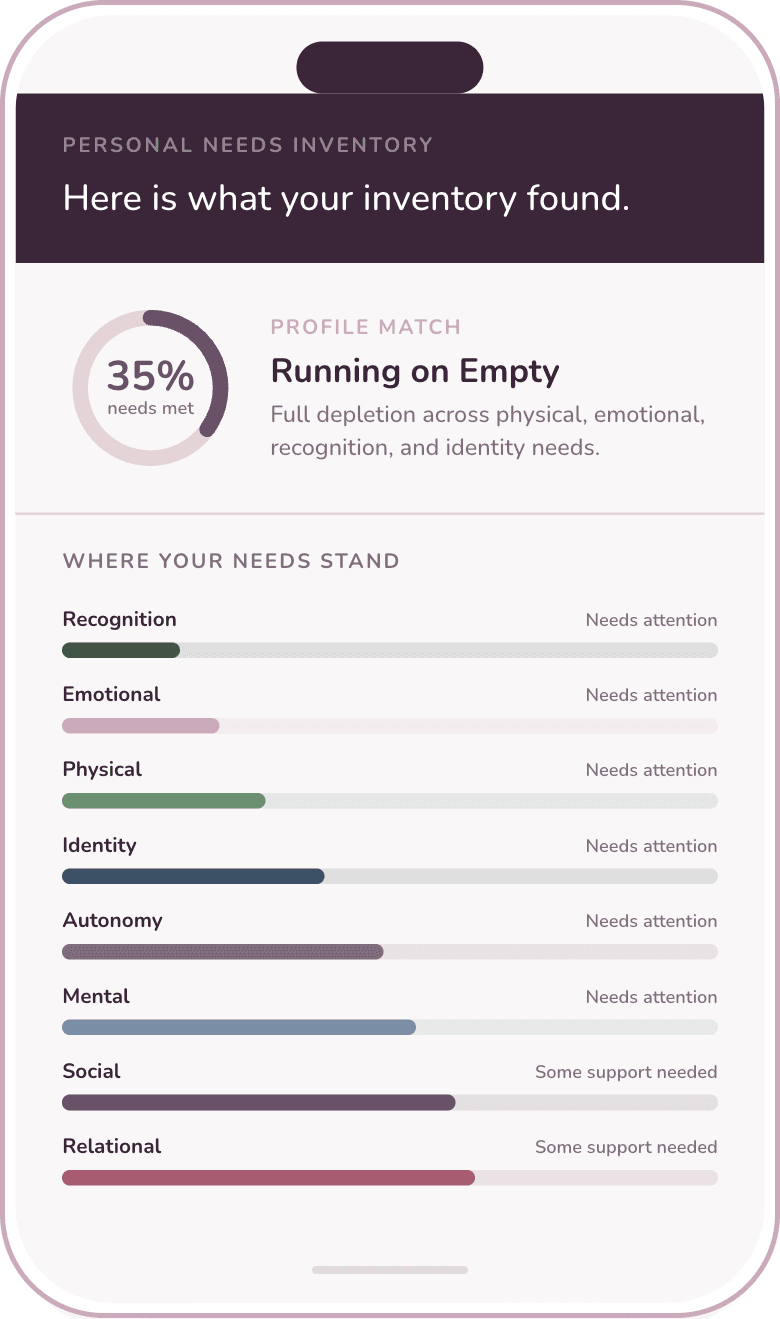
~5 minFreePersonal Needs Inventory
You already know something is off. The Personal Needs Inventory helps you get specific about what it is, across eight areas of your life, so you can finally see where to start.
The calm a child borrows in a meltdown has to come from somewhere, and it comes from you. When your own needs go unmet, the patience that hard behavior demands is the first thing to run out.
This is the quickest way to see where you are depleted, so the next tantrum meets a parent with a little more room to stay steady.

Will people judge my parenting if I get help?
Reaching for support is a sign of care, not failure.
- Help is an act of careChoosing to understand your child more deeply is one of the most caring things a parent can do. It reflects how seriously you take the relationship, not a shortfall in your ability to handle it.
- The space is nonjudgmentalTherapy is a place to make sense of what is happening without anyone keeping score of your parenting. You get to be honest about the hard moments and still be met with understanding.
- Compassion replaces the shameWhen the guilt and frustration ease, you have more room to parent with clarity and warmth. The work moves you from self-blame toward steadier, more grounded responses in the moments that used to undo you.
Free tools and resources
Learn more about behavioral challenges, free and at your own pace.



What clients say
Mom-centered, judgment-free care on your terms.
“I was struggling so much and feeling extremely overwhelmed as a new mother when I discovered Momwell. I thought I was the only one struggling and that there was something wrong with me for not being able to handle it all. After listening to the podcast, I’m feeling so much more like myself again! Motherhood is still hard, but I feel like I can finally breathe and enjoy it. Thank you, Erica!”
“I’d just gotten done crying after yelling at my children for the 100th time that day, feeling like I was a terrible mother, when I found the Mom Rage course. It was so comforting to hear people talking about exactly what I was going through–with NO judgment. I left with the tools I needed to recognize when I’m getting overwhelmed and bring myself back down. Our lives have gotten so much easier–I’m so grateful to Momwell!”