
Grieving a miscarriage or pregnancy loss
Pregnancy loss is more than a physical experience. It carries deep emotional and psychological effects. Whether it was an early miscarriage, recurrent losses, a stillbirth, or a loss due to medical complications, grief can take many forms.
Whether you have experienced a miscarriage, stillbirth, or loss at any stage, your grief is real and valid. You don’t have to go through this alone.

What it looks like
You might be struggling with your loss if you are...
Grief after loss can take many forms. You might benefit from therapy if you are:

Common questions

It was early, so should I really be this upset?
However early the loss, your grief is real, and there is no stage too soon to mourn the baby you were already holding in your heart.
- The love was already realThe hopes and dreams you carried for your baby were real from the moment you knew they were there. A loss does not erase that love, and the size of your grief simply reflects the size of what that pregnancy meant to you.
- There is no gestational cutoff for griefGrief does not measure itself in weeks, and an early loss can hurt every bit as much as a later one. Your feelings are completely valid no matter when the loss happened, and no one gets to decide how much it is allowed to weigh.
- Comparison only deepens the silenceWhen the world treats an early loss as something small, it can leave you grieving alone and wondering if you have the right to. You do, and your grief deserves the same gentleness you would offer anyone else carrying this.



Is an early loss still a real loss?
An early loss is a real loss, and the baby you hoped for and the future you imagined are worth grieving, no matter how few weeks it was.


Will talking about my loss make others uncomfortable?
Your grief deserves space, and you do not have to shrink it to protect anyone else. The people who love you want to walk alongside you, not be spared from it.
- Your grief is not a burdenIt can feel safer to stay quiet than to risk an awkward silence or the wrong words back. But carrying it alone is heavier than sharing it, and your loss is worth speaking, not hiding.
- The right people want to be let inThose who care about you would rather sit with you in the hard than have you face it by yourself. Letting them in, even imperfectly, is how you stop feeling so alone in the loss.
- A therapist can hold what others cannotNot everyone in your life will know how to be with this grief, and that is not a failing on your part. Therapy offers a space built to hold it, where nothing you feel is too much.
Key terms
Words for the grief of loss
Loss after pregnancy is often grieved in silence, with few words for it. Naming what you are carrying can make it a little easier to hold, and a little easier to ask for support.
- What counts as a pregnancy loss?
- Any loss of a pregnancy is a real loss, whether it was a chemical pregnancy, an early or missed miscarriage, a stillbirth, or a loss after fertility treatment. There is no point at which the love and the hopes you carried stop counting, and there is no stage too early to grieve.
- How long does grief after miscarriage last?
- Grief after loss has no set timeline and no finish line, and it can come in waves long after the people around you have moved on. You are not behind, and you are not grieving wrong, however long it takes and however it returns.
- Is it normal to feel this much grief after an early loss?
- It is deeply normal, even when the world treats an early loss as something small. The dreams and the bond were already real to you, so the grief is real too, and the pain you feel is a measure of how much that pregnancy meant.
- How can I support my partner after a loss?
- Partners often grieve a loss too, sometimes quietly or in ways that look different from your own, and neither way is wrong. Making room for each other’s grief, without needing it to match, can help you feel less alone in the same loss.

Should my partner and I be grieving the same way?
Grief looks different for everyone, and the two of you can love and miss the same baby while carrying it in very different ways.
- Partners grieve too, sometimes quietlyA partner may grieve in ways that look nothing like yours, throwing themselves into tasks or going silent rather than crying. That difference is not a lack of love, and it does not mean the loss matters less to them.
- Different does not mean disconnectedWhen grief shows up on different timelines, it is easy to feel suddenly alone inside the same loss. Naming that out loud, instead of guessing at each other, can keep the distance from growing.
- You can find your way back to each otherLoss can strain even a strong relationship when each of you is hurting in your own way. Therapy can help you understand each other’s grief and find connection through it, rather than around it.
Free tool
~5 minFreePersonal Needs Inventory
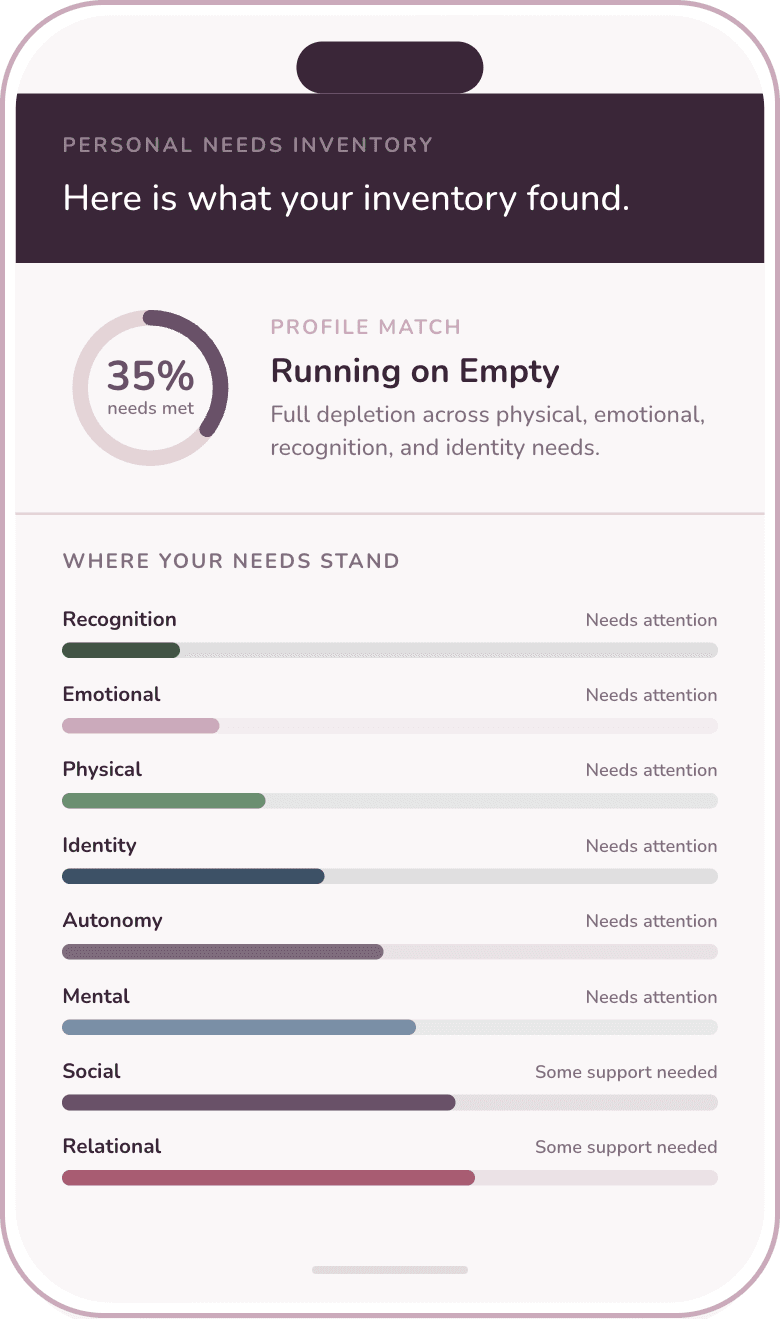
You already know something is off. The Personal Needs Inventory helps you get specific about what it is, across eight areas of your life, so you can finally see where to start.
Grief takes so much out of you, and it is easy to lose track of what you need while you are simply getting through the days. This is a quiet, no-pressure way to notice where you are most depleted.
You leave with a small snapshot of where to start, so caring for yourself feels a little less out of reach in a season that is asking everything of you.

Shouldn’t I be over it by now?
Grief is not something to get over, and there is no clock you are running behind on. It is something you slowly learn to carry, in your own way and your own time.
- Healing has no timelineThere is no point by which you are supposed to be done, no matter what anyone implies. Grief moves at its own pace, and taking the time you need is not falling behind.
- Grief comes in wavesIt can soften for a while and then return on a due date, a holiday, or for no clear reason at all. That return is not a setback or a failure to heal, it is simply how loss keeps company with love.
- The grief changes shape over timeOver time the grief often changes shape rather than disappearing, becoming something you hold alongside the rest of your life. Carrying it gently, with support, is its own kind of healing.

If I get pregnant again, will everything feel better?
A new pregnancy may bring hope, but it does not erase the baby you lost. Healing is about making room for all of it, not trading one feeling for another.
- A later pregnancy does not replace this oneThe baby you lost was their own, and no future pregnancy fills the exact place they held. Hope and grief can live side by side, and one does not cancel the other out.
- Pregnancy after loss can stir up fearCarrying again often brings anxiety and bracing alongside any hope, especially after a loss. Those mixed feelings are normal, and they do not mean you are ungrateful or doing it wrong.
- Your grief still deserves tendingMoving forward does not require leaving the loss behind, and the grief still asks to be felt. Making space for it, rather than rushing past it, is what lets the healing be real.

Does anyone understand what I’m going through?
Your grief is your own, and it is also a path so many have quietly walked. Support exists to help you feel seen, heard, and understood in it.
- Loss is common, even when it feels invisiblePregnancy loss is far more common than the silence around it suggests, touching so many who never speak of it. Knowing that does not shrink your grief, but it can ease the loneliness of carrying it.
- Feeling unseen is part of the painWhen others do not know what to say, it can leave you feeling profoundly alone in your loss. That isolation is one of the heaviest parts, and it is exactly what support is meant to soften.
- You deserve to feel understoodTalking with someone who truly gets this kind of loss can help you feel heard rather than handled. Therapy offers a place to be fully met in your grief, without having to explain why it hurts.
How therapy helps
Momwell can help you
Losing a pregnancy is a heartbreaking and deeply personal experience. You deserve a compassionate space where your grief is acknowledged, your emotions are validated, and your healing is nurtured.

Process your grief
There is no “right” way to grieve. Therapy helps you understand and work through your emotions in a way that feels right for you.
Address guilt and self-blame
It’s common to wonder if you could have done something differently. Therapy provides reassurance and tools to manage feelings of guilt and self-doubt.
Find ways to honor your loss
Your experience matters. Therapy can help you find meaningful ways to acknowledge and honor your pregnancy and your baby.
Navigate relationships and communication
Loss can impact your relationship with your partner, family, and friends. Therapy helps you express your needs and strengthen connections.
Manage anxiety about future pregnancies
Pregnancy after loss can bring complex emotions. Therapy offers support and coping strategies as you navigate hope and fear.
Support you through your healing journey
You deserve a compassionate space where your grief is acknowledged, your emotions are validated, and your healing is nurtured.
Free tools and resources
Gentle support you can reach for any time.



What clients say
Mom-centered, judgment-free care on your terms.
“I was struggling so much and feeling extremely overwhelmed as a new mother when I discovered Momwell. I thought I was the only one struggling and that there was something wrong with me for not being able to handle it all. After listening to the podcast, I’m feeling so much more like myself again! Motherhood is still hard, but I feel like I can finally breathe and enjoy it. Thank you, Erica!”
“I’d just gotten done crying after yelling at my children for the 100th time that day, feeling like I was a terrible mother, when I found the Mom Rage course. It was so comforting to hear people talking about exactly what I was going through–with NO judgment. I left with the tools I needed to recognize when I’m getting overwhelmed and bring myself back down. Our lives have gotten so much easier–I’m so grateful to Momwell!”