
What is maternal burnout?
Maternal burnout is a state of emotional, mental, and physical exhaustion caused by the excessive and prolonged stress of carrying motherhood with too little support. It builds slowly, over months and years of being needed around the clock with no real break.
It builds from the invisible load you carry, the erosion of the parts of yourself that are not "mom," and needs of your own that never make the list. When the demands stay high and the rest and support stay low for long enough, this kind of depletion is the predictable result.

What it looks like
The depletion that rest alone does not fix
It builds so slowly that many moms do not name it until they are deep in it. Any of these can be part of it.

Common questions

Why am I so exhausted when it feels like I am not getting anything done?
Burnout is not ordinary tiredness, and one good night of sleep will not fix it. It is deep depletion from too much demand and too little support.
- It drains you on three frontsYou are wrung out emotionally, you feel distant from the people and things you used to enjoy, and no amount of getting done ever feels like enough. Sleep alone does not reach any of that.
- So much of the work is invisibleThe planning, remembering, anticipating, and emotional caretaking do not land on a to-do list or get marked done. You can spend every ounce of energy and still feel like you accomplished nothing.
- Effort with nothing to show for it wears you downYou pour out energy all day and almost none of it looks "done," and that mismatch between how hard you are working and how little it registers is exhausting on its own.



Why do I feel like I have lost myself in motherhood?
Burnout in motherhood is not only exhaustion. It is also the slow erosion of the person you were before everyone else came first.
- Your own needs moved to the bottomWhen every hour goes to someone else, your own needs stop making the list at all. Going without rest, food, or a minute to yourself for long enough leaves you running on nothing.
- The parts of you that are not "mom" got shelvedThe interests, friendships, and pieces of yourself you used to make room for quietly fall away. Losing touch with who you are outside the role is its own depletion, not vanity.
- No part of the day is yoursWith no clean stretch of hours that belongs to you, there is nowhere for the tank to refill. Care with no recovery built into it is what wears a person down.
Key terms
The language of maternal burnout
Naming what is happening takes some of its power away. These are the terms that make maternal burnout easier to see and to talk about.
- What is maternal burnout?
- A state of emotional, mental, and physical exhaustion that builds from the prolonged stress of carrying motherhood with too little support. It is driven by the invisible load, the erosion of your sense of self, and chronic unmet needs.
- What is the invisible load?
- The planning, remembering, anticipating, and emotional caretaking that runs a family but never shows up on a to-do list. It is real work, and carrying most of it is one of the biggest drivers of burnout.
- What does running on empty mean?
- Spending energy you no longer have, long after your own reserves have run dry. Most moms are not just pouring from an empty cup, they are trying to fill everyone else’s with one.
- What is survival mode?
- When your body runs on stress and willpower instead of rest, bracing through each day rather than living it. Stay there long enough and the body eventually forces a stop, which is what burnout is.


How do I recover from burnout when I can’t just stop being a mom?
You do not recover by trying harder. Burnout is what trying harder got you. Recovery starts by reexamining your expectations and triaging the load, deciding what truly has to happen and what can wait.
- Reexamine and adjust your expectationsLook at the standards you have been holding yourself to and triage the load: decide what truly has to happen today, and let the rest wait without guilt. You cannot pour from an empty cup, and most moms are trying to fill everyone else’s long after their own has run dry.
- Give your needs a seat at the tableYour own rest and needs belong alongside your family’s, not dead last. Making room for them is not selfish, it is what makes it possible to keep showing up for the people you love.
- Move the stress out of your bodyBurnout leaves stress stuck in your body. Part of recovery is learning to complete the stress response and discharge what builds up physically, and reaching for support, including therapy, when the load is bigger than one person can carry.
How therapy helps
How therapy helps with burnout
Burnout rarely resolves by adding one more strategy to an already overflowing plate. It eases when the load gets lighter, the support gets real, and you stop being the only person holding everything together. A maternal mental health therapist can help you get there.

Reduce stress and overwhelm
We’ll guide you in creating a plan to manage the mental load of motherhood and access the support you need to feel more grounded.
Reexamine the expectations draining you
Together we look at the impossible standards you have been holding yourself to, and practice adjusting the ones that are draining you, so your expectations match your real capacity instead of a myth.
Give your needs a seat at the table
We help you treat rest, support, and your own needs as real priorities that sit alongside everyone else’s, and find language to ask for what you need without feeling selfish.
Share the load, not just survive it
When resentment has built up, we help you move from keeping score to a clearer conversation about how the labor at home can actually be shared.
Is maternal burnout the same as postpartum depression?
They overlap, but they are not the same thing. Burnout is depletion from stress and too little support, and it can open the door to depression.
- Burnout is depletionIt is the exhaustion that builds from prolonged stress and not enough support or rest. On its own it is not a mental health diagnosis, but it is real and it deserves to be taken seriously.
- Depression and anxiety can ride alongsidePostpartum depression and anxiety are mental health conditions that can develop on top of, or alongside, that depletion. Untreated burnout can drive someone deeper toward them, which is why catching it early matters.
- Reach out if it feels persistentIf your low mood, hopelessness, or anxiety feels persistent, that is worth bringing to a professional. A therapist can help you tell the difference and get the right kind of support.

Is feeling this way just part of being a mom?
Hard days are part of motherhood, but constant depletion, dread, and resentment are not the price of admission. Burnout is a sign that something needs to change in your support and your load, not a verdict on the kind of mom you are.
Free tools and resources
Start with what you need, free and at your own pace.
Free tool
~5 minFreePersonal Needs Inventory
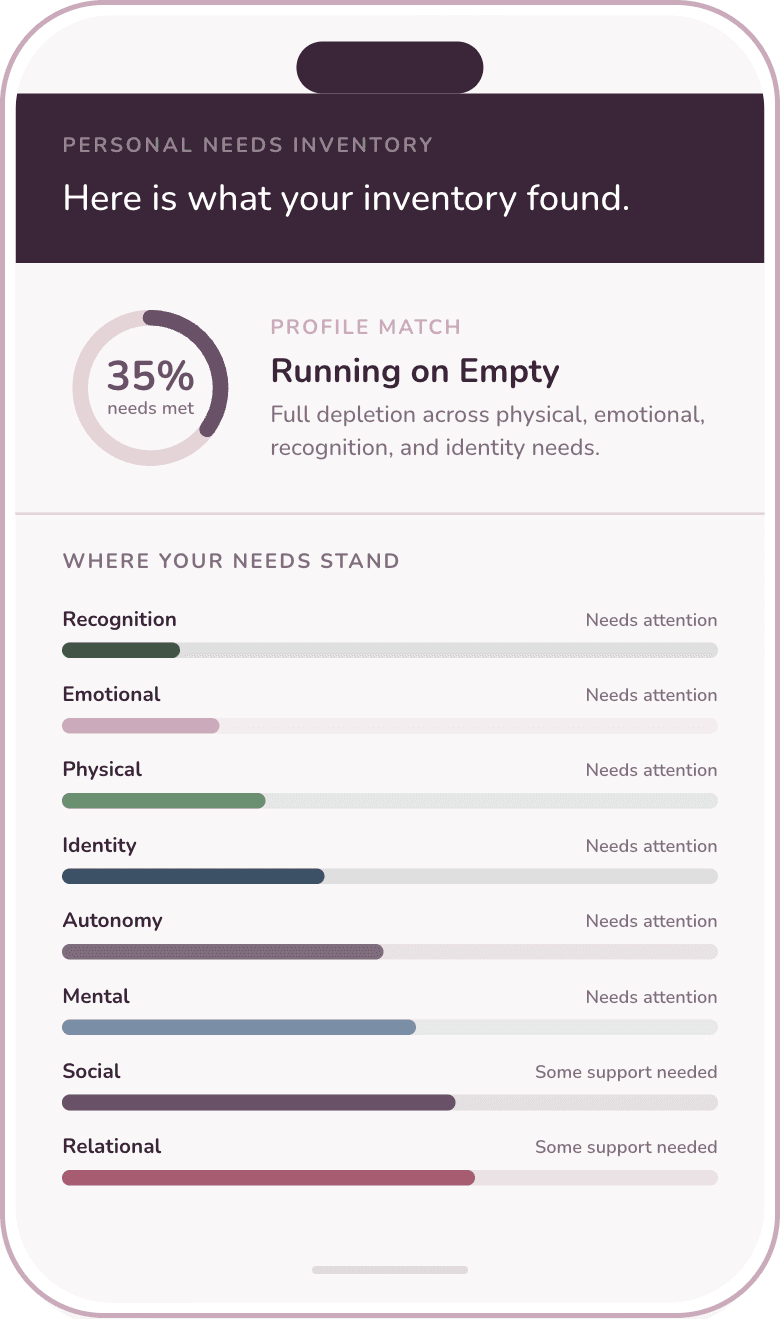
You already know something is off. The Personal Needs Inventory helps you get specific about what it is, across eight areas of your life, so you can finally see where to start.
Burnout builds in the gap between everything you are carrying and the rest and support you actually get. This maps exactly where you are most depleted, so that gap becomes something you can act on.



What clients say
Mom-centered, judgment-free care on your terms.
“I was struggling so much and feeling extremely overwhelmed as a new mother when I discovered Momwell. I thought I was the only one struggling and that there was something wrong with me for not being able to handle it all. After listening to the podcast, I’m feeling so much more like myself again! Motherhood is still hard, but I feel like I can finally breathe and enjoy it. Thank you, Erica!”
“I’d just gotten done crying after yelling at my children for the 100th time that day, feeling like I was a terrible mother, when I found the Mom Rage course. It was so comforting to hear people talking about exactly what I was going through–with NO judgment. I left with the tools I needed to recognize when I’m getting overwhelmed and bring myself back down. Our lives have gotten so much easier–I’m so grateful to Momwell!”