
What is default parent burnout?
Default parent burnout is the exhaustion that builds when you are the parent everyone turns to first, for every need, every decision, and every feeling, with no real break. The default parent is the one who is asked or assumed first, not just for tasks, but for managing the kids’ lives and holding the family’s emotions, and carrying all of that alone wears a person down.
This role rarely gets chosen on purpose. Most of us become the default parent without meaning to, without discussion, and without a plan, and the burnout that follows is the predictable cost of carrying a load meant to be shared on one set of shoulders, for too long.

What it looks like
When you are the one everyone needs, all the time
Being the default parent is more than doing a lot. It is being the one nobody else thinks to be. You might be carrying default parent burnout if you:

Common questions

How do I stop being the default parent?
Not by delegating from your list. You stop being the default parent by handing over whole areas of responsibility, not just individual tasks.
- Hand over the noticing, not just the doingThe default parent role lives in the thinking and tracking underneath the tasks, so swapping who unloads the dishwasher barely moves it. The real shift is giving your partner ownership of whole areas, the deciding and the remembering included, so the load actually leaves your plate.
- Let your partner build their own expertiseIt will be slower and messier than how you would do it, and the urge to take it back will be strong. Resisting that urge is the work, because every time you step in, you log another rep and your partner stays one step behind.
- Make the invisible visibleYou cannot share a load that only one of you can see, so the first move is getting it all out where you can both look at it. From there the conversation can move from keeping score to a clear, shared plan for who carries what.



What is a default parent?
The default parent is the one who is asked or assumed first, not just for tasks, but for managing the kids’ lives and holding the family’s emotions.
- It is the one the kids walk up toYou are the first stop for help, comfort, and answers, even when both parents are right there in the room. That default setting covers far more than chores; it includes the planning, the noticing, and the emotional care that rarely get counted as work.
- It usually lands on moms by defaultGender norms, social expectations, and the pressure to be and do more steer this role toward mothers long before anyone discusses it. Most of us become the default parent without meaning to, without a conversation, and without a plan.
- Being opted in with no say wears you downWhen you feel signed up for all of it without ever agreeing to it, the unfairness of that lands hard. That quiet frustration is exactly where default parent burnout begins to take root.


Why am I so burned out from being the default parent?
Because being the default parent is not one job, it is all of them at once, with no off switch.
- You hold every role at the same timeYou are anticipating needs, holding the schedule, noticing when something is off, making the decisions, and managing everyone’s feelings, all at once. Doing all of that day after day, often without any of it being seen as work, would deplete anyone.
- High demand, low relief, no end dateBurnout is what happens when the demand stays high and the relief stays low for a long stretch of time. As the default parent, the demand almost never lets up and the real breaks almost never come.
- Anyone doing this much would be this tiredThe depletion you feel is not a sign you are not cut out for this. It is the predictable result of carrying too much, for too long, with no one sharing the weight.
Key terms
The language of default parent burnout
Naming what is happening takes some of its power away. These are the terms that make the default parent load easier to see, and easier to talk about with your partner.
- What is a default parent?
- The parent who is asked or assumed first, for tasks, decisions, and feelings alike, even when both parents are in the room. It is a role most moms fall into without ever agreeing to it.
- What is default parent burnout?
- The depletion that builds when one parent carries the noticing, deciding, and emotional work of the whole family with no real relief. It is the predictable cost of high demand and low support stretched over time.
- What is the mental load?
- The invisible work of anticipating, tracking, and managing everything a family needs before anyone asks. It rarely shows up on any to-do list, which is why it is so easily missed by everyone but the person carrying it.
- What is the expertise trap?
- The loop where the more you do, the more you know, so everyone keeps assuming you should keep doing it. It is not that you are naturally better at it, only that you are the one logging the practice.

Why does the default parent role always fall to me?
Part of it is the gender norms you absorbed long before kids. Part of it is an expertise trap that keeps the role glued to you.
- You absorbed the script earlyLong before you had children, you were handed expectations about who manages a home and who keeps everyone cared for. Those norms quietly steer the default parent role toward moms before anyone makes a single decision about it.
- The more you do, the more it sticksYou might do it better than your partner, but only because you have logged years of practice they were never handed. Expertise is earned through reps, not wired in, which means it can be shared.
- Over-functioning teaches under-functioningWhen one partner over-functions, the other learns to under-function, and the imbalance quietly feeds itself. Redrawing that boundary, letting them fully own an area, including the consequences, is how the pattern unwinds.
How therapy helps
How therapy helps with default parent burnout
Default parent burnout rarely eases by carrying it better. It eases when the load gets shared, the resentment gets a productive outlet, and you stop being the only one holding everything together. A maternal mental health therapist can help you get there.

Reduce stress and overwhelm
We’ll guide you in creating a plan to manage the mental load of motherhood and access the support you need to feel more grounded.
Unpack the beliefs that keep you carrying it
Until we address the internal beliefs that tell us we have to hold it all to be “good moms,” sharing the load runs into major hurdles. Therapy is where that unlearning happens.
Communicate needs so they can be heard
When the imbalance comes out as criticism and blame, it strains the relationship. Therapy helps you find the language for what you are really feeling and needing.
Move from scorekeeping to sharing
When both partners can see the same picture, the conversation shifts from competing perceptions to shared language, and the load can actually be redistributed.

Is it normal to resent my partner as the default parent?
It is incredibly common. When you are opted into carrying almost everything with no say in it, resentment is a natural response to a real imbalance. So many moms describe doing the vast majority of the work while their partner does the lighter, fun parts, and feeling that imbalance build into anger. The resentment is information, pointing at a real inequity that deserves to be named and addressed. And your partner is not the problem, the social conditioning and defaulted assumptions are, which is why naming the system together works better than blaming each other.
Free tools and resources
See the load you are carrying, free and at your own pace.
Free tool
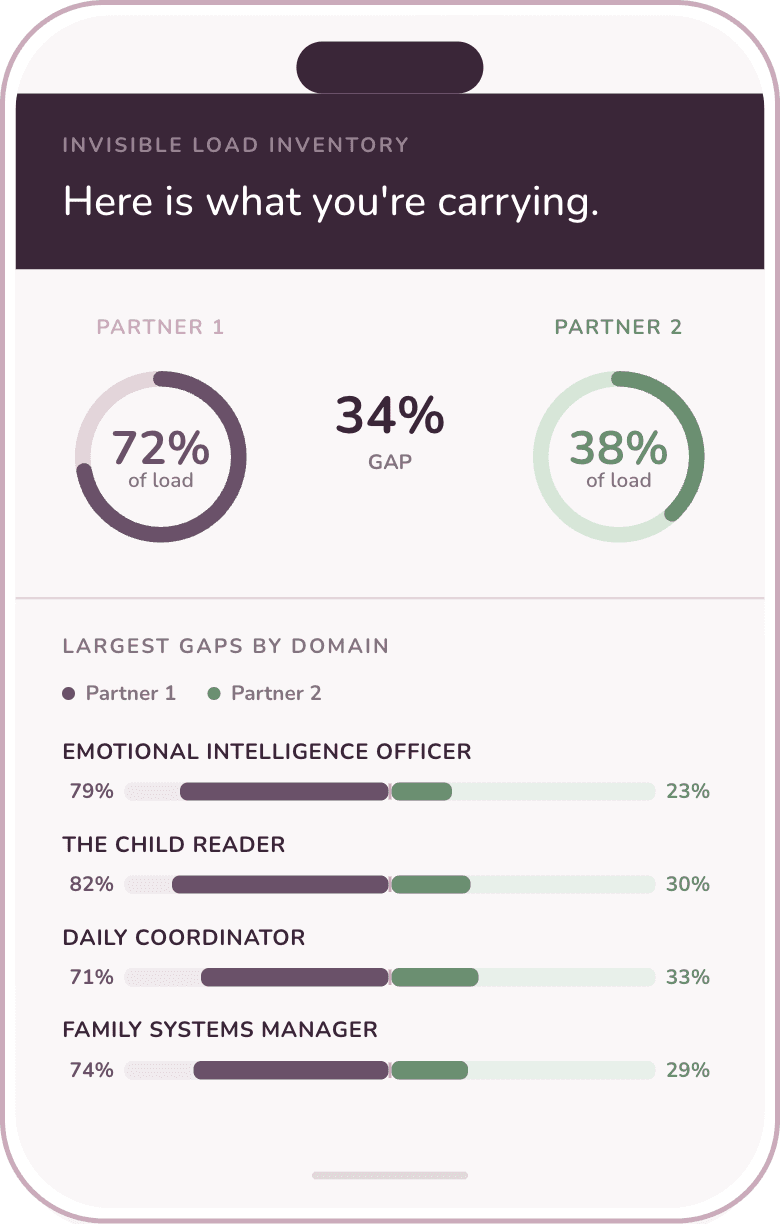
63 questions, 9 domains5 minsAlways freeThe Invisible Load Inventory
You already know something is off. Now you can both see it.
This inventory gives both of you something concrete to look at. Not to assign blame, but to finally be looking at the same thing.
Each partner completes the inventory independently. Your results map who is carrying what across all 9 domains, both perspectives, side by side.



What clients say
Mom-centered, judgment-free care on your terms.
“I was struggling so much and feeling extremely overwhelmed as a new mother when I discovered Momwell. I thought I was the only one struggling and that there was something wrong with me for not being able to handle it all. After listening to the podcast, I’m feeling so much more like myself again! Motherhood is still hard, but I feel like I can finally breathe and enjoy it. Thank you, Erica!”
“I’d just gotten done crying after yelling at my children for the 100th time that day, feeling like I was a terrible mother, when I found the Mom Rage course. It was so comforting to hear people talking about exactly what I was going through–with NO judgment. I left with the tools I needed to recognize when I’m getting overwhelmed and bring myself back down. Our lives have gotten so much easier–I’m so grateful to Momwell!”